
Artemis II
NASA’s first crewed lunar mission in over 50 years proves deep space travel is back, and sparks a new cosmic love story
By Troy Tyrell, Owner of Tsquared Personal Training & WBN Correspondent
Vancouver, BC – April 10, 2026
📢 Subscription to WBN and being a Contributor is FREE.
👉 Click here to begin reading or writing with us!
Houston, We’re Back in Business
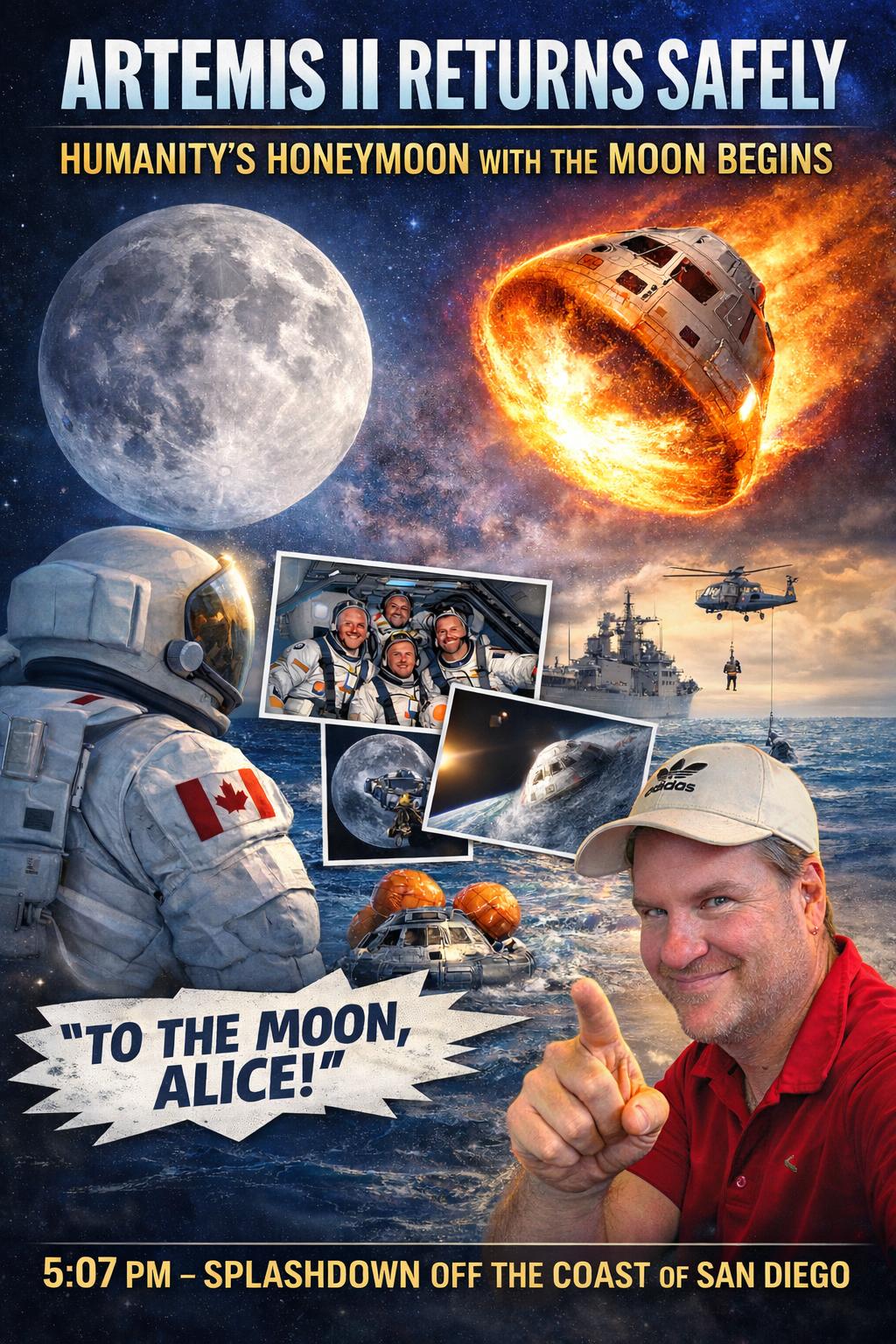
In a landmark moment for space exploration, Artemis II has successfully completed its 10-day journey around the Moon, returning its crew safely to Earth. Think of it as humanity’s first honeymoon trip back to the Moon in over 50 years, and somewhere up there, you can almost hear Ralph Kramden shouting, “To the moon, Alice!” except this time, we didn’t just talk about it, we actually went.
Historic Mission Success
NASA confirmed a safe Pacific Ocean splashdown of the Orion capsule at 5:07 p.m. Pacific Daylight Time on April 10, 2026, in a recovery zone off the coast of San Diego, California.
That moment marked the successful completion of the first crewed lunar mission since the Apollo era. The spacecraft traveled roughly 694,000 miles during its journey, looping around the Moon before returning home.
That distance might sound like a stat, but it represents something bigger. Humanity stepping back into deep space after more than five decades of hesitation, budget battles, and technological rebuilding.
The crew aboard Orion tested every critical system needed for long-duration space travel:
- Life support systems in deep space
- Navigation beyond Earth’s orbit
- Communication delays and blackouts
- Crew endurance under extreme conditions
This wasn’t a joyride. It was a full systems stress test, with humans onboard.
Integrity Landing, The Moment That Mattered Most
If there was one make or break moment, it was reentry.
After concerns from Artemis I, all eyes were on the Orion heat shield. During Artemis II, the capsule slammed into Earth’s atmosphere at extreme speeds, generating temperatures exceeding 2,700°C. For several minutes, communication with the crew was lost, a standard but nerve wracking blackout period.
And then, parachutes deployed.
And then, splashdown, right on target in the Pacific.
The spacecraft held together. The heat shield performed. The crew came home safely.
In honeymoon terms, this was the first real test of the relationship, the argument phase, and everything held together without anyone throwing luggage out the airlock.
International Milestone, Canada Steps Up
This mission wasn’t just an American achievement.
With a Canadian astronaut onboard, the Canadian Space Agency cemented its place in the next era of space exploration. Canada’s role in the Artemis program, particularly through robotics like Canadarm3, has positioned it as a key contributor to future lunar missions.
For Canadians, this is more than a proud moment. It is leverage:
- Access to future missions
- Participation in lunar infrastructure
- Opportunities for Canadian companies in aerospace, AI, and robotics
Not bad for a country better known for hockey and politeness.
Private Sector Pressure, The Spotlight Shifts
While NASA has successfully proven that humans can travel to the Moon and back, the next challenge lies in actually landing there.
That responsibility now falls heavily on SpaceX, which is developing the Human Landing System for upcoming Artemis missions.
Here is the situation in plain terms:
- NASA built the ride to orbit and back
- SpaceX is building the ride to the Moon’s surface
And right now, timelines are tight.
Artemis II was the wedding.
Artemis III is supposed to be the honeymoon on the Moon.
But if SpaceX is not ready, that honeymoon might get delayed.
Economic Impact, Why This Matters Beyond Space
This mission is not just about exploration. It is about economics.
Space is rapidly becoming a multi billion dollar industry, and missions like Artemis II validate the infrastructure needed to support it.
For Canada and cities like Vancouver, the impact is real:
- Increased demand for aerospace engineering
- Growth in AI and robotics sectors
- New opportunities in advanced manufacturing and materials science
Historically, space programs have led to technologies that filter into everyday life:
- GPS systems
- Advanced medical imaging
- Wearable fitness technology
- High performance materials used in sports equipment
The same way the internet started as a government project, space infrastructure is now evolving into something much bigger.
From Honeymoon to Long Term Commitment
With Artemis II successfully completed, humanity has taken a decisive step back into deep space. The mission proved that the systems work, the risks can be managed, and the path forward is viable.
But this is just the beginning.
The next phase will determine whether this renewed relationship with the Moon becomes a long term commitment, or just a very expensive fling.
Either way, one thing is clear.
We are not just looking at the Moon anymore.
We are going back.
Your Seat at the Table in the Space Economy
As global investment in space accelerates, Canadian businesses, innovators, and entrepreneurs have a rare opportunity to get involved early. The industries being built today will shape the next generation of technology, jobs, and economic growth.
Because if this honeymoon phase goes well,
The next step is not just visiting the Moon.
It is staying there.
By Troy Tyrell, ttyrell@wbnn.news, Founder of Tsquared Personal Training
WBN Contributor | Community Builder | Mountain Biker | Advocate for Local Business & Fitness
📍 Google Business Profile – Tsquared Personal Training,
🔗 Connect on LinkedIn
📘 Follow on Facebook
Tags:
#Artemis II #NASA #Space Exploration #Canada In Space #WBN News Vancouver #Troy Tyrell #Integrity