As British Columbia marches toward a transformative 2026, Premier David Eby finds himself at a critical junction. His premiership has marked a departure from the traditional labour-focused NDP of the past, replaced by a technocratic, activist approach that seeks to use the full weight of the provincial government to solve BC's most stubborn crises. But with a record-breaking deficit and a shifting political landscape, the "Eby Experiment" is facing its toughest test yet.
The Vision: Activism over Consensus
David Eby’s platform is defined by a "results-at-all-costs" philosophy. Unlike his predecessor, John Horgan, who often sought broad consensus with stakeholders and municipalities, Eby has proven willing to override local authority to mandate housing density and reshape urban landscapes. His "ultimate goal" is to decouple the housing market from speculation, effectively turning BC into a laboratory for state-led affordability.
His agenda is being fuelled by an unprecedented spending spree. The $13.3 billion deficit projected for the 2026/27 fiscal year—a staggering leap from the $6 billion surplus left by Horgan just three years ago—is being funnelled into 29 new hospitals, massive SkyTrain expansions, and a complete overhaul of the primary healthcare system.
The Economic Headwinds: A Weakening Dollar and Global Events
The timing of this spending coincides with significant external pressures. A weakening Canadian dollar has increased the cost of imported goods and construction materials, further inflating the price tag of Eby’s infrastructure dreams.
However, the government is betting on a "rebound effect" from 2026’s marquee events. The FIFA World Cup and major tech gatherings like Web Summit are expected to inject billions into the local economy. Eby is positioning these events not just as celebrations, but as essential catalysts to prove that BC remains a global destination despite the domestic fiscal strain.
The Critique: Does Intervention Help or Hurt?
Despite the NDP’s stated mission to protect the marginalized, a growing chorus of critics argues that the government's policies are suffering from "unintended consequences."
- The Supply Paradox: Critics argue that aggressive rent caps and new taxes on higher-valued properties ($3M+) have created a "chilling effect" on private investment.
- The Trickle-Down Burden: There is a rising concern that the costs of a ballooning bureaucracy (with 15,000 public sector roles currently under review for efficiency) eventually "trickle down" to the poor through increased service costs and a stifled job market for entry-level workers.
The Opposition: A New Challenger Emerges
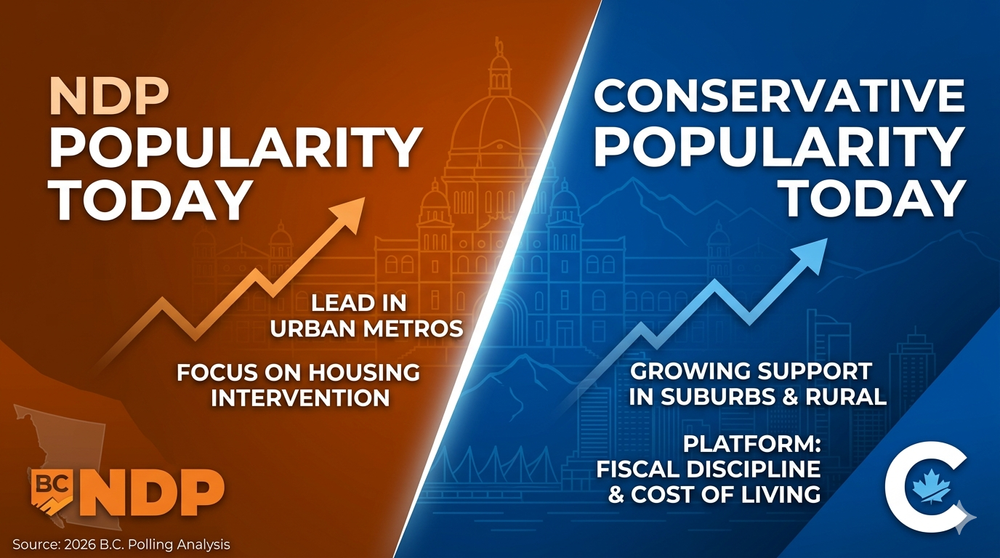
For the first time in a decade, the NDP faces a statistically significant threat from the right. While David Eby's personal approval has slipped to a new low of 37%, the BC Conservative Party is surging.
Recent March 2026 polling suggests that if the Conservatives select a "centrist-leaning" leader like Peter Milobar in their May 30 leadership race, they could secure a majority. Milobar is currently polling with a 5.5-point lead over Eby among decided voters, largely by capturing the "soft" middle-class vote in Vancouver and the suburbs—voters who are increasingly wary of the province’s debt-to-GDP ratio, which is set to breach 30% this year.
The Counter-Argument: The Risk of Doing Nothing
The NDP remains undeterred. Finance Minister Brenda Bailey and Premier Eby argue that the deficit is "productive debt." Their stance is that in a high-interest-rate environment, the government must act as a shield. By investing in $10-a-day childcare and BC Builds, they argue they are providing a direct "income boost" to families that far outweighs the theoretical risks of a high deficit.
While the BC NDP’s platform is explicitly designed to support the poor and marginalized through direct subsidies and rent controls, critics argue that these policies often trigger a "trickle-down" hardship that inadvertently harms those they aim to protect.
- Housing Stagnation: Aggressive rent caps and "flipped" market mandates can lead to a "chilling effect" on new rental construction. When developers pull back due to narrowed margins, the resulting supply shortage drives up competition for the few remaining units, leaving low-income earners with fewer options and aging infrastructure.
- The Cost of the Deficit: The record $7.9 billion deficit (rising toward a projected $13.3 billion by 2026) necessitates future fiscal tightening. Historically, massive debt leads to "service inflation" or eventual austerity measures, which typically impact the social safety nets that the marginalized rely on most.
- Operational Hurdles for Small Business: Policies intended to increase corporate accountability often manifest as increased overhead for the "mom-and-pop" shops in Vancouver’s Last Mile. As these businesses struggle with regulatory costs, they are often forced to raise prices on essential goods or reduce entry-level staffing, directly impacting the local community's affordability and employment.
In this light, the "activist government" approach faces a significant challenge: ensuring that the secondary economic consequences of their policies do not outpace the primary benefits intended for BC’s most vulnerable residents.
Elke Porter at:
Westcoast German Media
LinkedIn: Elke Porter or
WhatsApp: +1 604 828 8788.
Public Relations. Communications. Education
Let’s bring your story to life — contact me for books, articles, blogs, and bold public relations ideas that make an impact.
TAGS: #BCPolitics #DavidEby #BCBudget2026 #VancouverEconomy #FIFA2026 #BCNDP vs #BCConservatives