
Oscar Peterson At 100: Remembering A Canadian Jazz Legend
A visit to Oscar Peterson's centenary exhibition brings back memories of hearing the Canadian jazz legend perform live twice with my husband David.

A visit to Oscar Peterson's centenary exhibition brings back memories of hearing the Canadian jazz legend perform live twice with my husband David.
Karalee Greer | Vancouver City News | September 4, 2026
Subscription to Vancouver News is Free Being a Contributor is Free
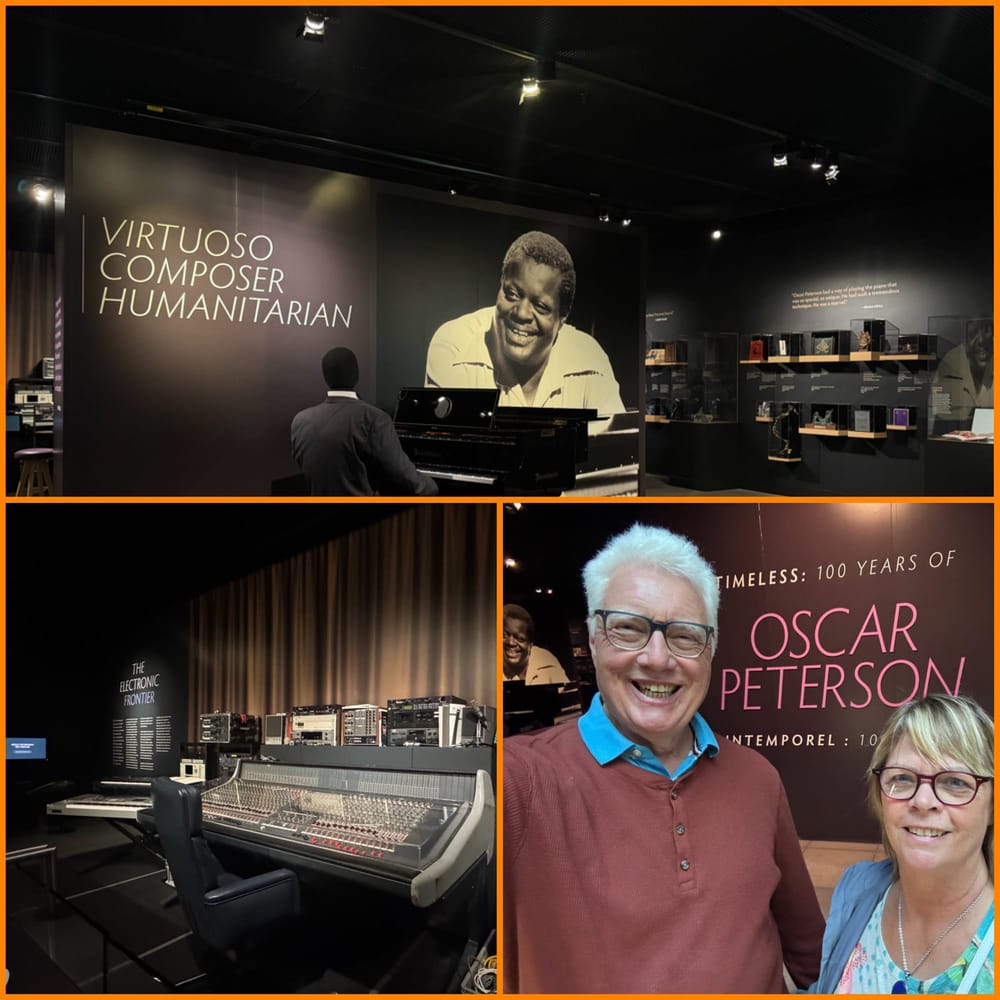
Walking through Studio Bell in Calgary this week, my husband David and I found ourselves doing more than looking back at the extraordinary career of Oscar Peterson.
We were remembering.
The National Music Centre's special exhibition, Timeless: 100 Years of Oscar Peterson, celebrates the 100th anniversary of the birth of one of Canada's greatest musicians.
For David and me, however, Peterson's music isn't something we know only from recordings, photographs or museum displays.
We had the privilege of seeing him perform live twice.
Standing together among the instruments, photographs and personal artifacts from his remarkable life brought those memories back and connected three experiences spanning decades.
Oscar Peterson was born in Montreal on August 15, 1925. Over a career spanning more than six decades, he became one of the world's most acclaimed jazz pianists and one of Canada's most internationally recognized musicians.
The National Music Centre's Timeless: 100 Years of Oscar Peterson exhibition traces that journey from Peterson's childhood in Montreal's Little Burgundy neighbourhood to the world's great stages.
Created in collaboration with Peterson's estate, the exhibition includes instruments and recording equipment from his home studio, awards, archival material, personal artifacts, interviews and performance footage.
It also explores something that can sometimes be overshadowed by Peterson's extraordinary ability at the piano: the man behind the music.
Timeless: 100 Years of Oscar Peterson at Studio Bell
Seeing the exhibition was particularly meaningful because David and I were fortunate enough to hear Oscar Peterson perform in person on two occasions.
The first was years ago at a hotel in North Vancouver. In late February or early March 1983, David and I saw Oscar Peterson perform with legendary guitarist Joe Pass at the Plazazz Showroom in North Vancouver. Peterson and Pass played an extended engagement there from February 28 through March 12.
I still remember what a privilege it was for us to be in the room and experience a musician of Peterson's stature at relatively close range.
Our second opportunity came many years later.
On June 25, 2004, David and I were at Vancouver's Orpheum Theatre when Peterson opened the TD Canada Trust Vancouver International Jazz Festival.
The theatre was full.
Peterson had suffered a stroke in 1993 that affected his left hand, and his touring had slowed considerably. Yet there he was, back at the piano before a Vancouver audience.
His quartet that evening included legendary Danish bassist Niels-Henning Ørsted Pedersen, guitarist Ulf Wakenius and drummer Jeff Hamilton. Coastal Jazz remembers the concert as Peterson's first West Coast appearance in roughly two decades.
Knowing what Peterson had overcome made seeing him that evening particularly memorable.
We weren't simply listening to one of the world's great jazz pianists. We were watching a legendary musician continue to share his gift after a stroke had affected the very physical ability upon which so much of his career depended.
UPI photographer Heinz Ruckemann captured Peterson at the piano that evening, preserving a photograph from a concert David and I were fortunate enough to experience firsthand.
Peterson's 1993 stroke could easily have ended his performing career.
For a pianist whose astonishing technique was central to his international reputation, losing strength and dexterity in his left hand presented an enormous challenge.
But Peterson returned to performing.
His playing necessarily changed, yet the musicianship, phrasing and unmistakable sense of swing remained.
That history made our experience at the Orpheum all the more meaningful.
We knew we were seeing Peterson later in his life and career. Looking back now, more than 20 years later, I appreciate even more what a privilege that evening was.
Peterson died in December 2007 at the age of 82.
One of the most important parts of Peterson's legacy extends far beyond jazz.
His composition Hymn to Freedom was written in 1962. Harriette Hamilton later added lyrics, and the song became associated with the Civil Rights Movement.
Its message of freedom, dignity and equality travelled far beyond the jazz world.
Then, decades later, it became part of an extraordinary moment in American history.
On January 20, 2009, Hymn to Freedom was among the music performed at the first presidential inauguration of Barack Obama, the first Black president of the United States. It was performed by the San Francisco Boys Chorus and San Francisco Girls Chorus as part of the inaugural program.
Peterson had died just over a year earlier and did not live to see that historic day.
There is something especially powerful about a composition by a Black Canadian musician, written during the Civil Rights era, becoming part of the inauguration of the first Black president of the United States.
It speaks to the reach of Peterson's legacy in a way that awards and record sales alone cannot.
Peterson's technical brilliance was legendary.
He was sometimes called "The Maharaja of the Keyboard," a nickname attributed to Duke Ellington, while his extraordinary speed and dexterity helped establish him as one of the most recognizable pianists in jazz.
But Peterson was much more than a virtuoso.
He was a composer, mentor and educator. He confronted racial discrimination during his own career and used his music to express ideas about dignity, equality and freedom.
He also remained distinctly Canadian while becoming an international star.
Peterson was the first artist inducted into the Canadian Music Hall of Fame in 1978. His many honours eventually included eight Grammy Awards, a Grammy Lifetime Achievement Award and recognition at the highest levels in Canada.
Yet perhaps his greatest legacy is that musicians continue to listen to, study and be inspired by his playing.
Peterson's story began in Montreal's Little Burgundy neighbourhood.
His father, Daniel Peterson, encouraged music among his children, and young Oscar initially studied both trumpet and piano. After contracting tuberculosis, he concentrated on piano.
What followed was an extraordinary international career.
Peterson performed with many of the greatest musicians in jazz and played concert halls around the world.
But Canada remained central to his identity.
A century after his birth, Canadians are still listening to his recordings, young musicians are still discovering his playing, and exhibitions like the one at Studio Bell are introducing his story to people who never had the opportunity to see him perform.
David and I were among the fortunate ones who did.
Twice.
More than two decades after that evening at the Orpheum, David and I found ourselves together again this week, this time walking through Studio Bell in Calgary.
Instead of waiting for Peterson to walk onto a stage, we were looking back over the life he had already lived.
Seeing his instruments, photographs and personal belongings and learning more about the history behind his music brought our own memories into the exhibition with us.
For us, Timeless: 100 Years of Oscar Peterson connected three moments separated by decades: hearing Peterson perform in North Vancouver, seeing him at the Orpheum later in his remarkable career, and now standing together at an exhibition celebrating 100 years since his birth.
That made our visit much more than a museum exhibition.
It felt like coming full circle.
Museums preserve objects, but at their best they also bring memories back to life.
Walking through the Oscar Peterson exhibition reminded me that music history isn't only about famous recordings, awards and dates.
It's also about the people who were there.
It's remembering sitting beside my husband in a Vancouver theatre as one of Canada's greatest musicians took his place at the piano.
It's remembering the sound of his music filling the Orpheum.
And it's standing together more than two decades later, looking at the story of his life and realizing just how fortunate we were to have heard him ourselves.
Oscar Peterson would have turned 100 on August 15, 2025.
His centenary gives Canadians an opportunity to celebrate not only an extraordinary jazz musician, but a Canadian whose music reached far beyond our borders.
For David and me, the celebration also brought back two very special memories.
We saw Oscar Peterson play.
And all these years later, his music still resonates.
Timeless: 100 Years of Oscar Peterson is at Studio Bell, home of the National Music Centre, in Calgary. The exhibition is presented in the National Bank Special Exhibitions Gallery on Level 5 and has been extended into early 2027.
National Music Centre – Studio Bell
Karalee Greer | Vancouver City News
LinkedIn: https://www.linkedin.com/in/karalee/
Subscription to Vancouver City News is Free Become a Contributor for Free
Tags: #Oscar Peterson #Canadian Jazz #Studio Bell #Vancouver International Jazz Festival #Orpheum Theatre #Karalee Greer #Vancouver City News