By Elke Porter | WBN News Vancouver | March 23, 2026
Subscription to WBN and being a Writer is FREE!

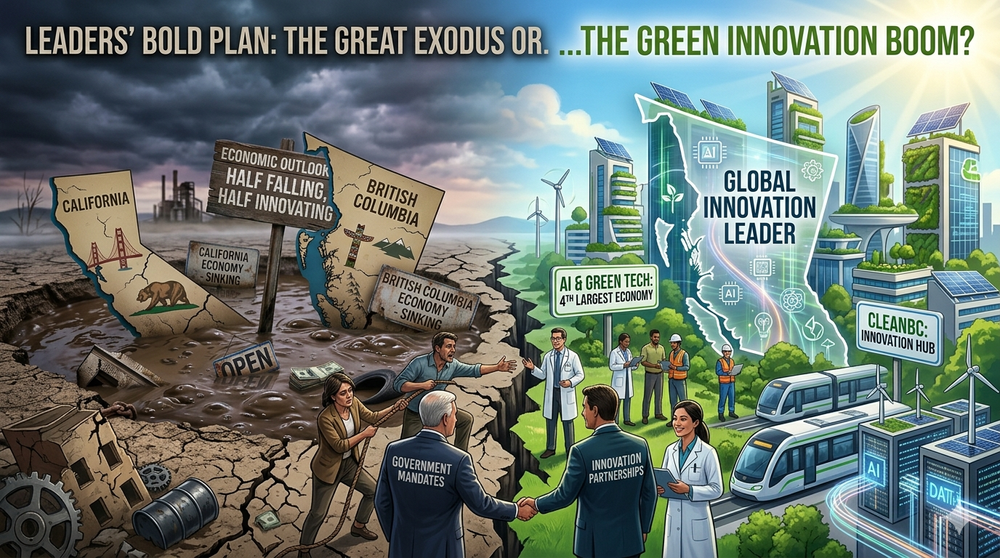
The "Left Coast" often feels like a mirror image across the 49th parallel. California Governor Gavin Newsom and British Columbia Premier David Eby lead jurisdictions that share more than just a coastline; they share a political DNA rooted in progressive climate goals, aggressive housing intervention, and a struggle to keep their middle classes from fleeing to "cowboy" neighbours like Texas and Alberta.

As of early 2026, the data tells a consistent story. Last year, B.C. saw a historic shift with over 75,000 residents leaving the province, while California continued its trend of losing over 216,000 residents to domestic migration. Yet, simultaneously, California recently overtook Germany to become the world's 4th largest economy, and B.C. remains a North American leader in tech-sector growth.

Two Leaders, One High-Stakes Playbook

Newsom and Eby are often described as "ideological cousins." Both have leaned into a "Big Government" approach to solve systemic crises, betting that a painful transition today will lead to dominance in the 21st-century green economy.

  • Gavin Newsom has focused on "California Way" policies: statewide rent caps, massive investments in renewable energy, and stripping power from local cities to force housing density.
  • David Eby has mirrored this, notably through the "CleanBC" plan and legislation that effectively ended single-family zoning across much of the province to spark a "building boom."

5 Common Struggles: The Price of the Pacific Coast

The economic outlook for both regions is defined by five distinct "pain points" that act as quicksand for the average resident.

1. The Housing "Death Grip"

In Vancouver and San Francisco, the price-to-income ratio remains among the highest in the world.

  • The Struggle: High interest rates have made mortgages prohibitively expensive, neutralizing local supply gains.
  • The Balance: According to the Vancouver Sun, B.C. is finally seeing record housing starts, but many argue the "red tape" and environmental fees built into the price still keep entry-level homes out of reach.

2. Grocery Price Acceleration

While grocery inflation cooled slightly in 2025, the "floor" for food prices has permanently shifted higher.

  • The Struggle: Global supply chain disruptions from the pandemic, the new war in Iran and the ongoing war in Ukraine remain primary drivers.
  • The Balance: Critics point out that B.C.’s carbon tax and California’s strict trucking regulations add "last-mile" delivery costs that make a basket of eggs more expensive than in neighboring states or provinces.

3. Energy and the "Oil Seesaw"

Gasoline in B.C. and California is consistently the most expensive in North America.

  • The Struggle: Global volatility causes massive price swings.
  • The Balance: Both leaders have restricted new refinery capacity in favour of electrification. While this creates a "Green Innovation Boom" for new industries, it places a heavy burden on those who still rely on fossil fuels for work and travel.

4. The "New Car" Barrier

The average price of a new vehicle has soared, partly due to EV mandates.

  • The Struggle: Newsom and Eby have both implemented bans on new gas car sales by 2035.
  • The Balance: As it stated in the New York Times, this mandate has spurred billions in investment for battery manufacturing and charging infrastructure, but it has simultaneously phased out the more affordable, entry-level internal combustion models.

5. Utility Costs in Private Homes

Heating and cooling have become luxury expenses.

  • The Struggle: Extreme weather events (heatwaves and atmospheric rivers) have forced higher consumption.
  • The Balance: B.C. is investing heavily in Site C for long-term hydro power, and California is upgrading its grid for wildfire safety. These are "future-proof" investments, but the "present-day" bill is being paid by homeowners through skyrocketing rates.

The Verdict: Choice vs. Global Chaos

How much of this is Newsom and Eby's doing? It is a balance of regulatory friction and global volatility.

FactorLocal Policy ImpactExternal/Global Impact
HousingHigh (Zoning, Permit Fees)High (Interest Rates)
FoodLow (Carbon/Transport Taxes)High (War, Global Yields)
EnergyMedium (Refinery Bans)High (OPEC+, Geopolitics)
InnovationHigh (Subsidies, Tech Focus)Medium (Global Venture Capital)

While the pandemic, war, and interest rates provided the "spark" for the current crisis, the specific policy choices of Newsom and Eby have created a unique environment: a powerhouse economy for the "innovation class," but a struggle for the middle class.

Alberta and Texas have become the "safety valves" for those who prefer lower taxes and a "pro-production" stance. The future for the "Left Coast" depends on whether Newsom and Eby can ensure their "Green Innovation Boom" actually reaches the kitchen tables of the people currently sinking into the economic quicksand.

Elke Porter at:
Westcoast German Media
LinkedIn: Elke Porter or
WhatsApp:  +1 604 828 8788.
Public Relations. Communications. Education

Let’s bring your story to life — contact me for books, articles, blogs, and bold public relations ideas that make an impact.

 TAGS:

  • #PacificCoastEconomy
  • #NewsomVsEby
  • #GreenInnovation2026
  • #HousingCrisisBC
  • #CaliforniaExodus
  • #EconomicOutlook
  • #Elke Porter
Share this article
The link has been copied!