
The Stolen Promise: Canada's (Maybe US, too) Forgotten Generation
How Canada's housing crisis, youth unemployment, and broken policies left Gen Z unable to own homes, find jobs, or build the futures Gen X took for granted.

How Canada's housing crisis, youth unemployment, and broken policies left Gen Z unable to own homes, find jobs, or build the futures Gen X took for granted.
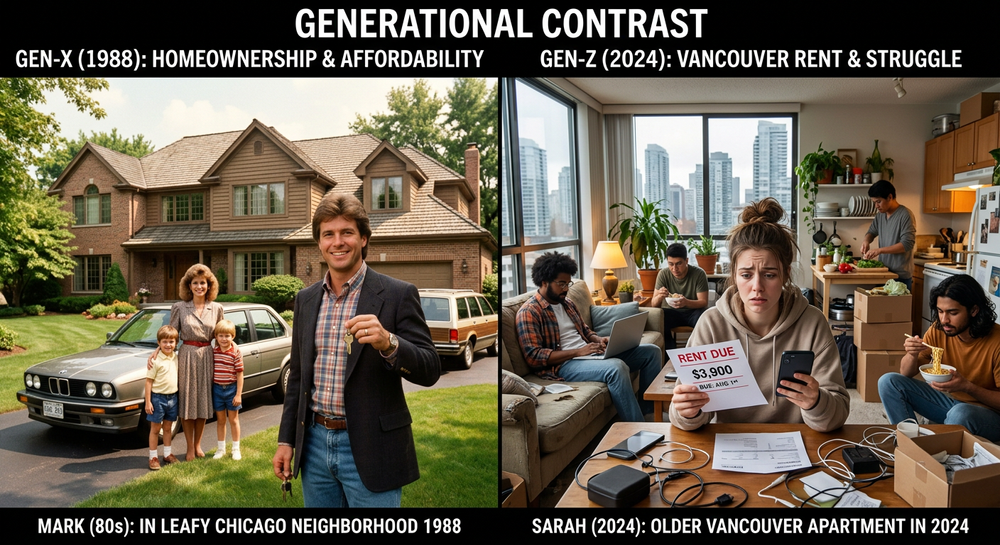
A generation that had everything built a system that offers their children almost nothing — and calls it progress.
Picture a family in suburban Canada, circa 1988. Dad works at the plant or the office. Mom may or may not have a job — it doesn't much matter financially, because one salary is enough. There's a mortgage on a detached house. There's a reliable car in the driveway, maybe two. Every summer, the family packs up and heads somewhere — the Maritimes, Florida, Banff. Money is set aside each month for retirement. The kids are expected to go to university, get a decent job, and do the same. This is not a wealthy family. This is a typical Canadian family.
Now picture the adult children of that family today, in 2026. They are in their late twenties and thirties. Many have university degrees — some have graduate degrees — and crippling student debt. They are renting an apartment they cannot afford in a city they can barely survive in. They commute by Uber because a car is too expensive and public transit is unreliable. They have no savings, no pension, and no realistic path to homeownership. Many have not taken a real vacation in years. They are one unexpected bill away from financial crisis. This is not an outlier story. This is the defining reality of Generation Z in Canada.
How did we get here? How did a country that gave one generation such a stable, comfortable foundation manage to dismantle it almost entirely for the next? The answer involves failed housing policy, explosive immigration mismanagement, the gig economy's quiet destruction of stable work, the intrusion of platforms like Airbnb into the housing supply, and governments at every level that have repeatedly chosen short-term optics over long-term stewardship. The result is a generation of young Canadians who are not lazy, not entitled, and not failing to try hard enough — they are being failed, systematically, by the institutions and policies that were supposed to work for them.
"Three-quarters of Canadian adults under 35 believe that owning a home is now a privilege reserved for the rich." — Ipsos, June 2024
Start with the most fundamental problem: work. In February 2026, Statistics Canada reported that the youth unemployment rate — for Canadians aged 15 to 24 — had climbed to 14.1 percent, approaching the recent high of 14.6 percent reached in September 2025, which itself was the highest level since 2010, excluding the pandemic years. To put that in plain language: Canada's youngest workers are navigating the worst job market in a generation. Their parents entered the workforce in the 1980s and 1990s facing recessions and high interest rates, but they found jobs. Today's young Canadians are finding very little.
Employment actually fell among youth aged 15 to 24 by 47,000 in February 2026 alone — a 1.7 percent drop in a single month. That same month, 22.8 percent of all unemployed Canadians — more than one in five — had been continuously searching for work for 27 weeks or more. The summer months have been no kinder: the unemployment rate for returning students in summer 2025 surpassed 20 percent, the highest non-pandemic level in over 25 years. These are not abstract data points. They represent hundreds of thousands of young Canadians with degrees and ambitions and no place to go.
The sectors that once absorbed young workers — retail, food service, entry-level office work — are shrinking their payrolls or automating them away. What was once a "mall job" stepping stone has largely evaporated. Cuts to the public sector, traditionally a reliable entry point for young graduates, have compounded the damage. Even AI is beginning to reshape the kinds of entry-level knowledge work that new graduates once depended upon. The result, as one economist noted, is what some are calling a "youth-cession" — a generational recession that is happening even while the broader economy avoids official recession status. Notably, all age groups over 30 are performing above expectations in the labour market. Only the young are falling behind.
Youth unemployment rate, February 2026: 14.1% (Statistics Canada)
Student summer unemployment, 2025: exceeded 20% — highest non-pandemic rate in 25+ years
Youth employment fell 47,000 in February 2026 alone (-1.7%)
Employment rate for young Canadians in August 2025: 60.5% — a low not seen since 1998
And yet, when young people speak about these realities, they are often met with dismissal — told they're not trying hard enough, that their generation is soft, that their parents had it harder with high interest rates. As one University of Toronto business graduate who spent a year searching for work told CBC, "It really pushes my buttons when other generations say that we're doing something wrong." He is right to push back. The data proves his point. This is structural, not personal.
If unemployment is the daily wound, housing is the open fracture. The story of homeownership in Canada across generations is one of the starkest examples of intergenerational inequality in any developed country.
In the 1980s, when Gen X parents were entering adulthood, a typical Canadian home cost between three and four times the average household income. That meant a family earning a median income of $25,000 to $30,000 a year could realistically save for a down payment and manage mortgage payments. Yes, interest rates were high — the Bank of Canada's overnight rate peaked near 21 percent in 1981 — but home prices were low enough to offset the borrowing cost. When rates fell through the 1990s, Gen X buyers who had purchased modest homes found themselves sitting on rapidly appreciating assets. The homeowner who bought in the late 1980s or 1990s has since watched their home value increase five or six times over. Many are now mortgage-free, with hundreds of thousands — sometimes millions — of dollars in equity.
The story for Gen Z is almost the inverse of every single advantage their parents enjoyed. Canada's home price-to-income ratio remained between six and nine until 2007, and since then has consistently exceeded nine, reaching ten in 2015, twelve in 2016, and climbing as high as sixteen in 2022. Today, in major cities, the average mortgage payment swallows more than 60 percent of a household's income. In the Greater Toronto Area, for non-condo properties, that figure has reached 81 percent — meaning eight of every ten pre-tax dollars earned go directly to the mortgage. A 20 percent down payment on an average Toronto home today requires over 25 years of saving for a median-income household, assuming ten percent of income is set aside each year.
"In 1981, 55% of Canadians aged 25-34 owned a home. By 2024, that figure had plummeted to just 36%." — Bank of Canada
The national homeownership rate fell from 69 percent in 2011 to 66.5 percent in 2021 — a loss of 2.5 percentage points in a single decade, driven almost entirely by young Canadians being priced out. In Ontario, the decline was even more pronounced, dropping from 71.4 to 68.4 percent over the same period. And since then, prices have only continued to rise relative to wages. In 1985, the median after-tax income for a Canadian worker aged 25 to 34 was approximately $51,000 in today's dollars. By 2022, that figure had inched up to just over $52,000 — a mere two percent increase over nearly forty years. House prices, meanwhile, rose by 337 percent between 2003 and 2018 in many cities. These numbers cannot coexist with anything resembling housing accessibility for ordinary young Canadians.
Home price-to-income ratio: 3-4x in the 1980s vs. 16x at peak in 2022
Average Toronto non-condo mortgage payment: 81% of pre-tax income (RBC Economics, 2023)
Years to save a 20% down payment in Toronto at 10% savings rate: over 25 years (National Bank of Canada)
Real wage increase for Canadians 25-34 from 1985 to 2022: approximately 2% (Statistics Canada)
Governments have not been entirely blind to the housing crisis. They have, however, been remarkably consistent in prioritizing the appearance of action over its substance. The clearest example is Canada's foreign buyer ban, introduced in January 2023 and periodically extended. The intent was straightforward: prevent non-Canadians from purchasing residential property and thereby reduce competition and lower prices for Canadian buyers. The reality was considerably less satisfying.
The ban contains so many exemptions — for temporary workers, international students meeting certain criteria, commercial properties, rural land, and buildings with four or more units — that its practical scope is narrow. More damning, non-residents owned only about two to six percent of Canadian residential properties in 2020, according to Statistics Canada. Their role in driving up prices, while real at the luxury end of certain markets, was never the primary cause of unaffordability.
As the chief economist for the B.C. Real Estate Association plainly stated, the ban "was more political than economic policy or housing policy." Many real estate experts have concluded that the ban was designed more to generate favourable headlines during an election cycle than to meaningfully address the structural causes of the crisis. When the ban's initial effects showed home prices easing, analysts attributed the change not to the ban but to the Bank of Canada's rapid interest rate increases that followed — a separate policy entirely.
Meanwhile, the more substantive levers — zoning reform to allow higher-density construction, investment in non-market housing, infrastructure spending to open up land supply — received comparatively little attention and even less money. Since 1989, per capita government spending on affordable housing stock actually fell from $115 per capita to $60 per capita by 2014. In 1982, the federal government built 20,450 affordable housing units; by 2006, that number had collapsed to just 4,393. The CMHC has warned that Canada needs 3.5 to 5.8 million new homes by 2030 to restore affordability. We are nowhere near that pace.
The contradiction is jarring. On one hand, the federal government has spent years talking about making housing affordable for young Canadians. On the other hand, it aggressively expanded immigration targets to 500,000 permanent residents annually for 2025 — a number that put enormous additional pressure on an already critically undersupplied housing stock.
The federal government's own 2025 budget document acknowledged that the "unprecedented rate of growth" in the temporary resident population had "put pressure on housing supply, the health care system, and schools" and was "no longer sustainable." That admission arrived years after the damage was done.
The immigration question is complex and deserves nuance. Canada's diversity and openness are genuine national strengths, and immigrants have contributed enormously to this country's economy, culture, and social fabric. The problem is not immigration itself — it is the mismanagement of immigration at a pace and scale that outstripped the country's infrastructure and, critically, its job market.
Between 2018 and 2024, the proportion of Canada's population comprised of temporary residents more than doubled, from 3.3 percent to 7.5 percent. By 2024, there were over three million individuals in Canada on valid temporary permits — workers, international students, asylum claimants — with the majority having no guarantee of permanent status and therefore no long-term claim on the communities they lived in. This population surge was not matched by a corresponding surge in housing supply, healthcare capacity, or job creation. Instead, it intensified competition in every market that young Canadians were already struggling to enter: the rental market, the entry-level job market, the post-secondary system.
The federal government allocated $598 million in the 2025-26 fiscal year to cover health care for asylum claimants and refugees, with another $411 million for 2026-27. These are meaningful commitments to vulnerable people arriving in Canada with nothing. But there has been no equivalent dedicated national program for the generation of Canadian-born citizens who also arrived at adulthood with nothing — no savings, no equity, no job security, no realistic path to the stability their parents took for granted.
Canadian students facing $28,000-plus in average undergraduate debt, record youth unemployment, and inaccessible housing have received Youth Employment Strategy dollars and summer job programs. The contrast in urgency and scale is difficult to ignore.
The post-secondary system itself reveals the same dynamic. For years, provincial governments across Canada underfunded their colleges and universities, allowing institutions to use high international student tuition — typically three to five times what domestic students pay — to cross-subsidize programs that the government should have been funding directly. When the federal government finally capped international student admissions, beginning in 2024, the institutions that had become dependent on that revenue began cutting programs and laying off staff.
As one college administrator put it bluntly: the provincial government had been "in denial about the extent of their own underfunding" for a decade, using international student fees as a substitute for actual policy. The students who suffered the consequences — both international students left in limbo and domestic students in programs being cut — were, once again, not the ones who designed the system.
Beyond government policy, a set of private platforms have quietly reshaped the economic landscape in ways that disproportionately hurt young Canadians. The most consequential are Airbnb in housing and Uber and Lyft in transportation — not because their impact is necessarily catastrophic in isolation, but because they epitomize a broader pattern: the normalization of economic arrangements that extract value from working people without offering them the stability of traditional employment.
On housing: The debate over Airbnb's impact on Canada's rental crisis has been fierce and somewhat inconclusive. The Conference Board of Canada, working with Airbnb data, concluded that short-term rentals accounted for less than 0.5 percent of housing stock in most neighbourhoods, and that their contribution to rent increases was minimal. McGill University's Urban Politics and Governance research group has offered a more critical assessment, suggesting that tens of thousands of units in major cities have been effectively removed from the long-term rental supply.
Toronto has since cracked down significantly, and estimates suggest that up to 5,000 units have returned to the long-term market since 2020. But the larger story is one of prioritization: in a city with a 1.3 percent vacancy rate, allowing any significant share of the housing stock to serve tourists rather than residents represents a policy choice — and it is one that consistently disadvantages renters, who skew younger and less wealthy.
On work: The ride-share economy promised flexibility and supplementary income. What it delivered, at scale, was the dismantling of the taxi industry — which, for all its flaws, provided regulated employment with defined income structures — and its replacement with a gig model in which workers bear all the risk and none of the benefits.
Uber and Lyft drivers in Canada earn wages that often fall below minimum wage after accounting for vehicle costs, insurance, fuel, and platform fees. They have no employer pension contributions, no paid sick leave, no employment insurance eligibility in most provinces. The same gig logic now pervades food delivery, home cleaning, construction contracting, and content creation.
What this means for Gen Z, who are disproportionately represented in gig and part-time work, is a labour market that looks active on paper — unemployment rates measured against the labour force — but offers far less security, upward mobility, and dignity than the employment structures that allowed their parents to build stable lives.
"87% of Canadian job seekers have worked a side gig at some point. Among Gen Z, 41% said they would work a side gig on company time if they thought they could get away with it." — Harris Survey, 2024
The cumulative weight of these pressures — unaffordable housing, scarce entry-level employment, precarious gig work, stagnant wages, and a political culture that seems to respond to every crisis with a press release rather than a policy — has produced something economists are only beginning to measure and society is only beginning to acknowledge: a generation of Canadians who have quietly given up on the future they were promised.
A Royal Bank of Canada poll found in April 2021 that 36 percent of non-homeowners under 40 had already abandoned hope of ever owning property. That number has almost certainly grown since. Young Canadians are delaying marriage, deferring children, forgoing education in fields they love in favour of fields they believe might pay — and finding, often, that neither calculation works out.
The NEET rate — the share of young people not in education, employment, or training — has been rising steadily among those in their early 20s who are not students, driven primarily by non-students unable to find work. They are not resting. They are not enjoying themselves. They are simply not finding any entry point into the economic life their country promised them.
This is not merely an economic problem. Research consistently links prolonged youth unemployment and housing precarity to deteriorating mental health, delayed development of adult identity, and long-term income scarring — meaning that young people who cannot find stable work in their early career years earn less for the rest of their working lives, even after the economy improves.
The youth-cession does not just hurt young people today. It diminishes their lifetime earning potential, their likelihood of homeownership, and their ability to fund their own retirements — in a country where the pension system already depends on younger workers supporting an aging population.
None of this is inevitable. It is the accumulated result of choices — choices made by governments, by developers, by institutions, and by a political class that has found it easier to manage the concerns of wealthy older homeowners, who vote reliably, than to build systems that work for young people, who vote less and organize rarely.
The Gen X generation that benefited from affordable housing, stable employment, and functioning public institutions did not create those conditions themselves. Those conditions were built by public investment, thoughtful policy, and a social compact in which the needs of the coming generation were treated as a legitimate priority. That compact has eroded — not because of any single dramatic policy failure, but through decades of incremental disinvestment, regulatory capture, and the quiet substitution of symbolism for substance.
Restoring it will require more than Youth Employment Strategies and summer job programs. It will require serious zoning reform that allows density and affordability to coexist. It will require sustained public investment in non-market housing that serves people who cannot compete in a casino real estate market. It will require labour regulation that extends real protections to gig workers and gives young Canadians the same foundation of security that their parents' generation took for granted. It will require immigration policy calibrated to the country's actual absorptive capacity — in housing, in jobs, in public services — rather than to GDP targets that look good in a budget document and produce misery on the ground.
And it will require honesty: an acknowledgment, from the political leaders and institutions that shaped this situation, that the promise made to an entire generation has been broken, and that repairing it is not optional.
"Unable to afford homes, [young Canadians] are delaying marriage and children while relying on financial support from their parents well into their thirties." — The Hub, 2025
Gen Z did not ask for luxury. They asked for what was ordinary. A job with a future. A home of their own. The ability to take a week off and not feel the financial floor give way beneath them. The chance to save — not for a yacht, but for retirement, the way their parents did, the way everyone assumed was simply how adult life worked. That is not an unreasonable demand. It is, in fact, the minimum a functioning society owes its young people. Canada has not delivered it. The question is whether anyone with the power to change that is paying enough attention to act — before an entire generation stops believing that anyone ever will.
All statistics drawn from Statistics Canada, the Bank of Canada, CMHC, RBC Economics, Desjardins, CBC News, The Hub, and other cited sources. Data current as of March 2026.
Elke Porter at:
Westcoast German Media
LinkedIn: Elke Porter or
WhatsApp: +1 604 828 8788.
Public Relations. Communications. Education
Let’s bring your story to life — contact me for books, articles, blogs, and bold public relations ideas that make an impact.
TAGS: #StolenPromise #GenZCanada #HousingCrisisCanada #YouthUnemployment #GenerationalWealth #CanadaFailed