
Investing
By Troy Tyrell | WBN News Vancouver | March 05, 2026
📢 Subscription to WBN and being a Contributor is FREE.
👉 Click here to begin reading or writing with us!
Global markets reacted quickly after new military strikes involving Iran signaled the possibility of a broader conflict in one of the most geopolitically sensitive regions in the world. Stock markets declined while traditional safe-haven assets such as the U.S. dollar and government bonds rose as investors moved toward safety.
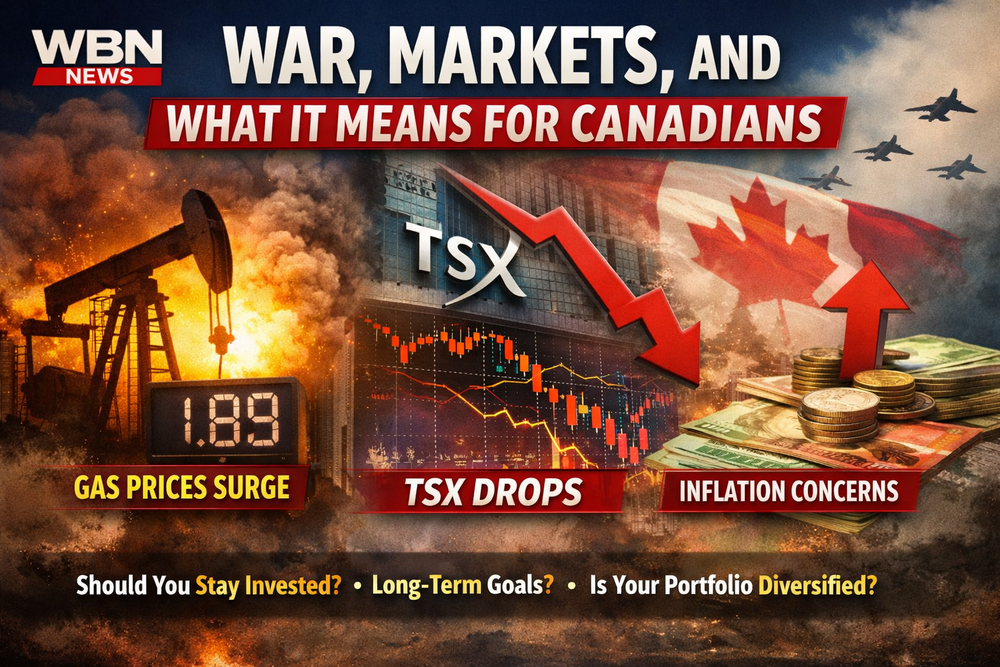
For Canadians, these global shocks are not just headlines. They can affect fuel prices, inflation, and even retirement portfolios.
Markets React to Geopolitical Risk
The reaction in financial markets mirrors what happened when Russia invaded Ukraine. In the days following that invasion, the S&P 500 dropped more than 7 percent, oil prices surged roughly 40 percent, and European natural gas prices jumped dramatically.
Despite the severity of that crisis, markets eventually stabilized and recovered. Today, four years after the start of that conflict, both U.S. and European stock markets sit close to record highs.
This historical pattern is one reason many financial professionals caution investors against making quick decisions during moments of geopolitical stress.
Why Investors Often Make Mistakes During Crises
Periods of uncertainty tend to amplify emotional reactions. Investors often feel pressure to sell investments when markets fall, fearing further losses.
History repeatedly shows that selling during panic moments often means missing the recovery that follows.
Market volatility triggered by wars or political events tends to be sharp but relatively short-lived when viewed over longer investment horizons.
What Canadian Investors Should Ask Themselves
Before making major changes to a portfolio during times of global conflict, financial advisors often suggest asking a few key questions:
• Can anyone accurately predict how the conflict will unfold?
• Is it possible to reliably forecast how markets will react?
• Will the event truly affect long-term financial goals?
• Have investment objectives actually changed?
• Is the portfolio diversified enough to withstand uncertainty?
In most cases, these questions highlight that reacting emotionally rarely improves long-term outcomes.
Potential Impact on Canadians
For Canadian households, the most immediate effect of global conflict often appears at the gas pump.
Rising oil prices can increase transportation costs, which eventually flow into food prices, airline tickets, and everyday goods. That can add renewed pressure to inflation.
However, Canada’s role as a major energy producer can also offset some economic impact. Higher global oil prices often benefit Canadian energy companies and energy-producing provinces.
The Long-Term Perspective
Geopolitical events can create real short-term volatility. Yet financial history shows that markets have weathered wars, crises, and political instability many times before.
For long-term investors, staying disciplined and diversified has historically proven far more effective than attempting to predict global events.
While headlines may shift daily, the core principles of investing remain remarkably consistent: patience, diversification, and a long-term outlook.
By Troy Tyrell, ttyrell@wbnn.news, Founder of Tsquared Personal Training
WBN Contributor | Community Builder | Mountain Biker | Advocate for Local Business & Fitness
📍 Google Business Profile – Tsquared Personal Training,
🔗 Connect on LinkedIn
📘 Follow on Facebook
Tags
#GlobalMarkets #VancouverRealEstate #TroyTyrell #WBNNewsVancouver #CanadianEconomy #Investing