By Arpi Sylvester | Vancouver City News | October 23, 2026 Editor: Karalee Greer
Subscription to Vancouver News and being a Contributor is Free

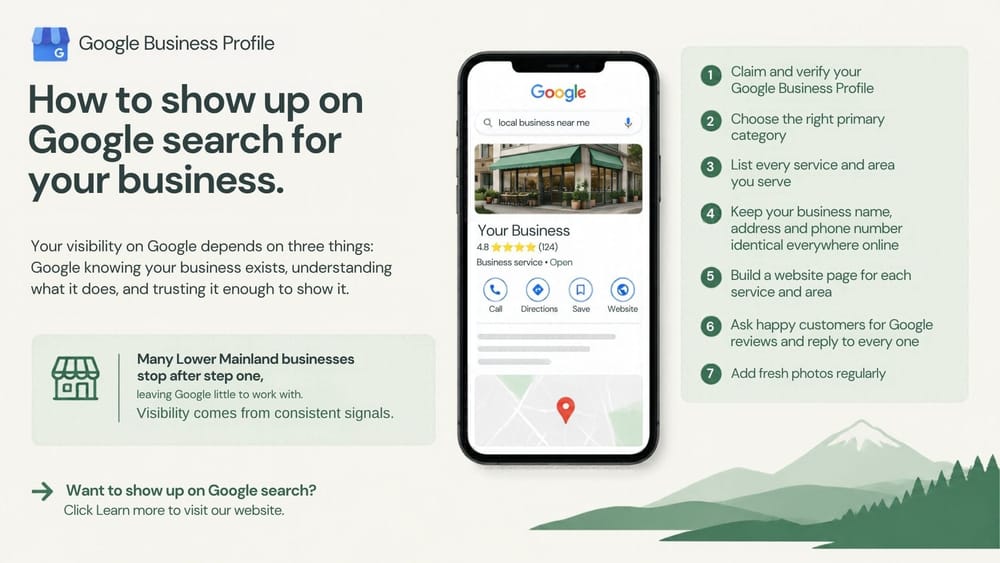
Local businesses need a verified Google Business Profile, a dedicated page for each service and area, and a steady flow of reviews to appear in Google search, according to Vancouver agency Hello Search Marketing.

For local businesses, Google search is often the first stop for new customers. Hello Search Marketing founder Arpi Sylvester says visibility comes down to one idea: Google shows businesses it can understand and trust.

Her guidance covers five steps, from claiming a free profile to making a website readable by search engines. The message for owners is that most of the work is basic and within their control.

What Happened

Hello Search Marketing published a plain-English guide to local visibility on Google. It explains that a business can appear in two places.

The first is the map results, often called the local pack. These show three businesses with a map when someone searches for something like “plumber near me.” They are drawn from Google Business Profiles.

The second is the regular results, the website links below the map. These come from a business’s own web pages.

Map results tend to bring calls and direction requests. Regular results tend to bring people who want to read, compare and ask for a quote. Most local businesses need both.

The Five Steps

1. Claim and verify a Google Business Profile. The profile is a free listing that controls how a business appears on Search and Maps. Without verification, owners have little control over what people see. The guide says to complete every field:

  • Exact business name, with nothing added
  • Primary category, described as the strongest ranking signal an owner controls
  • Secondary categories that match real services
  • Services with short descriptions
  • Service areas, hours, phone number and website link
  • Photos of work, team and location

2. Build one page for each service and area. A single “Services” page that lists everything rarely ranks for anything. Each page should say what the service is, who it is for and where it is offered, and what the customer should do next. The guide also says to use the words customers actually type, such as “emergency plumber Burnaby.”

3. Make business details match everywhere. Name, address or service area, and phone number should be identical across the website, Google profile, social pages and directories. Small differences, such as “Street” in one place and “St.” in another, create doubt.

4. Earn reviews steadily. The guide recommends asking every happy customer within a day or two of finishing the job, and replying to every review. A steady flow looks more natural than a burst followed by silence.

5. Make sure Google can read the website. The site should load fast on mobile and be added to Google Search Console with a sitemap submitted. No setting should tell search engines to stay away, which the guide says often happens after a website rebuild. Each page needs a clear title, a clear heading and a natural mention of location.

By The Numbers

  • 3: Businesses shown in the map results
  • 5: Steps in the guide
  • 164 to 287: Monthly booked jobs for one Vancouver plumbing client, a gain of about 75%
  • $136 to $101: Cost per booked job for the same client, a drop of about 26%
  • Days: Time a new, verified profile can take to appear
  • Weeks: Time website pages can take to be indexed, with ranking taking longer

The agency says the plumbing results followed a complete profile, service pages built around customer searches, and steady reviews. The company is not named, and the figures come from the agency itself.

Business Impact

The guide points to a common gap. Many small firms have a website but no page that matches what a customer types into Google. A broad page can lose to a competitor with a focused one.

The guide also lists why competitors often rank higher: a more complete profile, more reviews, or pages that match the search more closely. All three are fixable without paid advertising. A profile and website listing are free, while ads are a separate option.

Looking Ahead

The guide adds that AI tools such as ChatGPT, Gemini and Perplexity pull business details from the same sources Google does. When those details match, these tools can describe a business correctly. If true, consistent information now serves two audiences: search engines and AI assistants.

Competitive searches take the longest to win. Owners should expect weeks, not days, for website results.

Why It Matters

The signal for local businesses is that visibility is built on clarity and trust, not tricks. Complete profiles, focused pages, matching details and steady reviews are low-cost steps that compound over time.

As customers use both search engines and AI assistants to find providers, inconsistent or incomplete business information may cost leads. Firms that fix the basics first are better placed to hold their spot as search tools change. Next, owners should audit their profile, check that their site is not blocking search engines, and build a simple routine for requesting reviews.

By Arpi Sylvester LinkedIn: https://www.linkedin.com/in/arpisylvester/ Contact: arpi@hellosearchmarketing.ca

Company: Hello Search Marketing Website: https://hellosearchmarketing.ca/ Company LinkedIn: https://www.linkedin.com/company/hello-search-marketing/home/

Editor: Karalee Greer
Subscription to Vancouver News and being a Contributor is Free

Tags: #Local SEO #Google Business Profile #Google Search #Small Business #Digital Marketing #Online Reviews #Search Engine Optimization #Vancouver Business #Local Search #AI Search

Share this article
The link has been copied!