Karalee Greer | Vancouver News | April 20, 2026
Subscription to Vancouver News and being a Contributor is Free.
After a boat runs aground along Kitsilano Beach or near the entrance to False Creek, the first question is often how it got there.
The second is more pointed: who pays to clean it up?
Under Canadian law, the answer is clear—at least on paper.
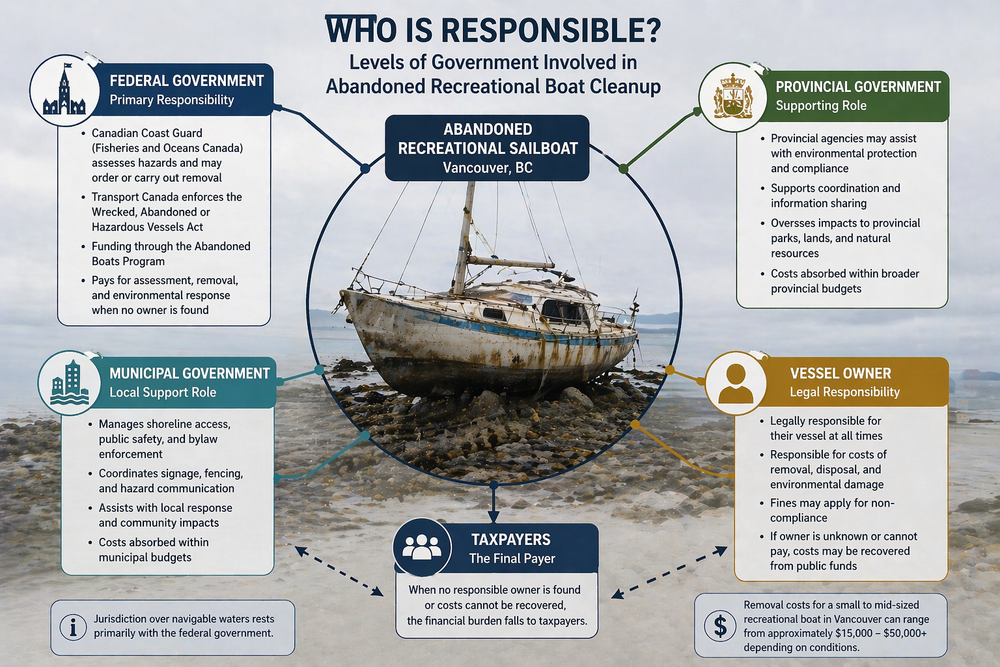
Vessel owners are legally responsible for their boats, including removal and disposal, under the Wrecked, Abandoned or Hazardous Vessels Act. The legislation was introduced to address the growing number of abandoned and hazardous vessels in Canadian waters, placing accountability directly on ownership (https://www.tc.canada.ca/en/marine-transportation).
But in practice, the situation is often more complicated.
In many cases, boats that end up on Vancouver’s shoreline are older vessels with unclear ownership. Registration numbers may be missing, outdated, or difficult to trace. Even when an owner is identified, they may not have the financial resources to deal with a wrecked boat, especially when removal costs can reach tens of thousands of dollars.
When that happens, responsibility begins to shift.
The Canadian Coast Guard, part of Fisheries and Oceans Canada, can step in if a vessel is deemed a hazard to navigation or a risk to the environment. Their role is not automatic, however. Each situation is assessed based on priority, including the presence of fuel, debris, or immediate safety concerns (https://www.canada.ca/en/fisheries-oceans.html).
If intervention is required and no responsible owner steps forward, the cost of removal may ultimately fall to the federal government.
In other words, taxpayers.
Programs have been developed to address abandoned and wrecked vessels across Canada, but funding is not unlimited. This means decisions must be made about which vessels are removed quickly and which remain in place while resources are allocated.
A closer look at local incidents shows how these costs add up.
Looking to Reduce Your Credit Card Fees? Click here
In Vancouver, smaller recreational boats grounded along Kitsilano Beach and near the entrance to False Creek are typically removed using cranes or marine salvage crews, depending on access and conditions. While individual project costs are not always publicly disclosed, industry estimates suggest that removing a small to mid-sized sailboat or powerboat in these environments can range from approximately $15,000 to $50,000.
These operations often involve:
• specialized lifting equipment
• coordination with tides and shoreline access
• safe handling of fuel or hazardous materials
While each individual boat may seem minor, the cumulative cost of repeated incidents adds up quickly.
At the provincial and municipal level, involvement is more limited.
The Government of British Columbia and the City of Vancouver may assist with coordination, shoreline management, or public safety measures, but they are generally not responsible for marine vessel removal. Jurisdiction over navigable waters remains primarily federal.
That division of responsibility is part of what makes the system feel slow and, at times, unclear.
For those watching from the shoreline, a grounded boat can appear to be a simple problem with an obvious solution. But behind the scenes, it involves legal responsibility, jurisdictional boundaries, cost considerations, and environmental assessment.
And until those pieces align, the boat often stays exactly where it landed.
As more vessels continue to wash ashore along Kitsilano Beach and the entrance to False Creek, the broader question remains:
Is the current system effectively holding owners accountable, or quietly shifting the burden elsewhere?
Meanwhile, residents including myself, continue to ask questions and walk past these eyesores on our seashores.
Editor: Karalee Greer
LinkedIn: https://www.linkedin.com/in/karalee/
Subscription to Vancouver News and being a Contributor is Free.
Tags: #Vancouver City News #Kitsilano #False Creek #Karalee Greer #Recreational Boating #Public Policy #Vancouver Beaches