Karalee Greer | Vancouver City News | May 31 - June 6, 2026
Subscription to Vancouver News is Free Being a Contributor is Free

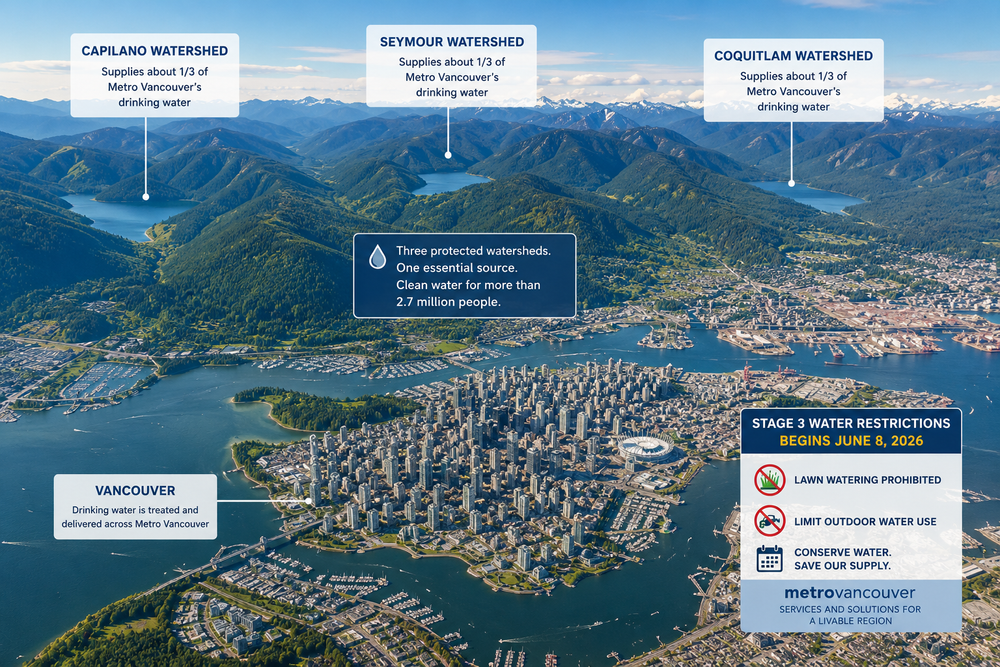
Beginning June 8, Metro Vancouver will move to Stage 3 water restrictions as the region responds to ongoing dry conditions and growing concerns about summer water supplies.

For many residents, the announcement raises an obvious question: Why are water restrictions necessary in a region famous for its rain?

Vancouver receives more than 1,200 millimetres of rainfall annually and is often associated with wet weather. Yet despite this reputation, the region's drinking water system depends on careful management of a finite supply that must last through the driest months of the year.

SPONSORED

Looking to Reduce Your Credit Card Fees? Click here

The move to Stage 3 restrictions reflects the reality that rainfall alone does not determine how much water is available for use. Instead, Metro Vancouver relies on a combination of reservoir storage, snowpack levels, seasonal demand, and long-term planning to ensure a reliable supply of drinking water for more than 2.7 million residents.

Under Stage 3 restrictions, lawn watering remains prohibited and additional limits are placed on outdoor water use. The goal is to reduce demand and preserve water supplies as summer approaches.

Most residents are already familiar with lawn watering restrictions, but the larger story is how Metro Vancouver's water system actually works and why conservation measures become necessary even in a rainy climate.

Unlike many cities that rely on groundwater or major rivers, Metro Vancouver obtains nearly all of its drinking water from three protected mountain watersheds.

The Capilano Watershed, located on the North Shore behind Cleveland Dam, supplies a significant portion of the region's drinking water. The Seymour Watershed, also located on the North Shore, provides another major source. To the east, the Coquitlam Watershed supplies a substantial share of the region's water and plays an increasingly important role during periods of peak demand.

These watersheds are closed to public access in order to protect water quality. Rainfall and mountain snowmelt collect in reservoirs before being treated and distributed throughout Metro Vancouver.

Many people assume that because it rains frequently in Vancouver, water supplies are constantly replenished. However, the system depends heavily on winter snowpack stored in the surrounding mountains.

As temperatures rise during spring and summer, snow gradually melts and replenishes reservoirs. When snowpack levels are lower than normal or dry weather arrives earlier than expected, reservoir levels can decline more quickly.

At the same time, water demand rises significantly during the summer months.

Outdoor watering, gardens, landscaping, tourism, construction activity, and increased household use all contribute to higher consumption. Even small increases in daily water use can have a significant impact when multiplied across millions of residents.

Climate patterns are also becoming less predictable. Longer dry periods and warmer temperatures are increasing pressure on water systems throughout British Columbia. While Metro Vancouver remains fortunate to have access to high-quality mountain water sources, conservation is becoming an increasingly important part of managing those resources responsibly.

The Stage 3 restrictions scheduled to begin June 8 are intended to help ensure that water remains available for essential needs throughout the summer. Drinking water, sanitation, firefighting, food production, and critical services remain the highest priorities.

For residents, the restrictions serve as a reminder that even abundant natural resources require careful stewardship.

The region's mountain watersheds continue to provide some of the highest-quality drinking water in the world, but maintaining that supply depends on balancing available water with seasonal demand.

As Metro Vancouver enters another summer, the restrictions highlight a simple reality: living in a rainy city does not guarantee unlimited water. Responsible use today helps ensure a reliable supply for everyone tomorrow.

Editor: Karalee Greer
LinkedIn: https://www.linkedin.com/in/karalee/
Subscription to Vancouver News is Free Being a Contrubutor is Free

Tags: #Vancouver City News #Metro Vancouver #Water Restrictions #Climate Change #Environment #Community News #Karalee Greer

Share this article
The link has been copied!