Karalee Greer | Vancouver City News | July 1, 2026
Subscription to Vancouver News is
Free Being a Contributor is Free

Property taxes are due Friday, July 3, for Vancouver homeowners and businesses. Before you pay your annual tax bill, it's worth understanding where your money goes and how it helps fund the services and infrastructure that keep the city running every day.

Most people focus on the amount owing. Few stop to ask a simple question:

Where does all that money actually go?

Before The Deadline

If you own property in Vancouver, your 2026 property taxes are due Friday, July 3.

Payments received after the deadline are generally subject to a 5% penalty, with an additional 5% penalty applied to any outstanding balance after September 2, 2026.

Property owners eligible for the BC Home Owner Grant or the Property Tax Deferment Program must also apply by the July 3 deadline to avoid penalties.

The City recommends allowing extra time for online banking transactions or mailed payments to ensure they arrive before the deadline.

Who Actually Receives Your Property Taxes?

One of the biggest misconceptions is that the City of Vancouver keeps all of your property tax payment.

It doesn't.

The City collects property taxes on behalf of several organizations. Your property tax notice includes amounts that are distributed to different taxing authorities responsible for providing municipal, regional, and provincial services.

Your property taxes help fund:

  • City of Vancouver services
  • Metro Vancouver regional services
  • TransLink
  • Provincial School Tax
  • BC Assessment
  • Municipal Finance Authority
  • Regional emergency management and other legislated services

The City acts as the collector before distributing the appropriate portions to each organization.

What The City's Share Pays For

The City's portion of your property taxes helps fund many of the services residents rely on every day.

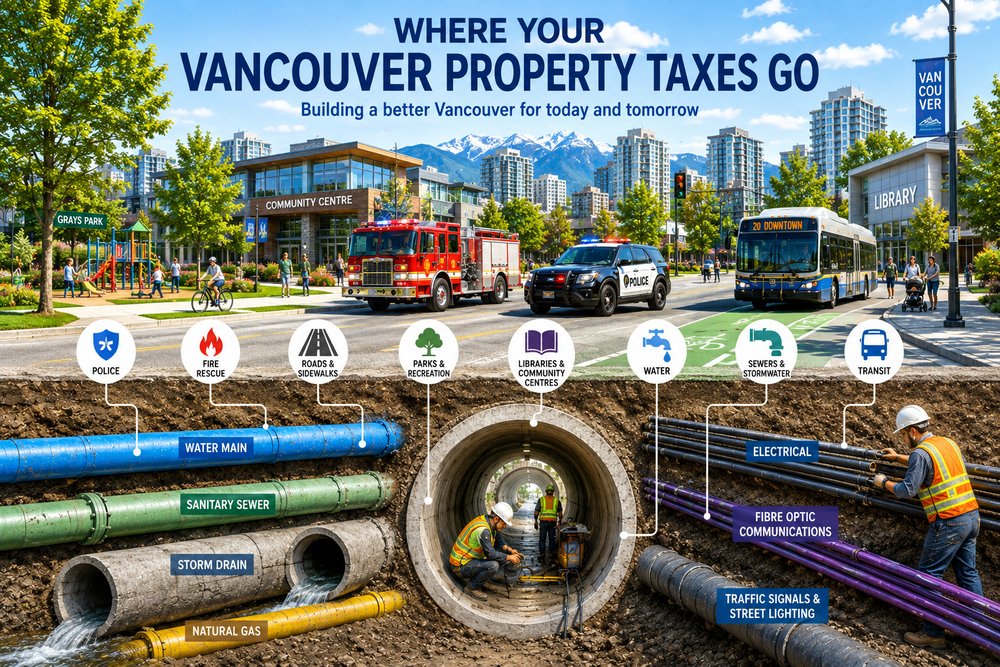
These include:

  • Vancouver Police Department
  • Vancouver Fire Rescue Services
  • Road maintenance
  • Sidewalks and bike routes
  • Parks and beaches
  • Community centres
  • Public libraries
  • Street lighting
  • Urban forestry
  • Traffic signals
  • Engineering services
  • Planning and development
  • Emergency preparedness
  • Recreation facilities

These are the visible services we often notice. But a significant portion of the City's investment goes into infrastructure that most people never see.

The Hidden Infrastructure Beneath Your Feet

One of the largest investments funded through City budgets is hidden beneath Vancouver's streets.

Underground is an extensive network that keeps the city functioning every day.

It includes:

  • Drinking water mains
  • Sanitary sewers
  • Stormwater systems
  • Electrical infrastructure
  • Natural gas lines
  • Fibre optic communications
  • Traffic signal infrastructure

When roads are dug up, crews are often replacing or upgrading these underground systems rather than simply repairing the pavement above them.

Vancouver's Infrastructure Is Aging

Many of Vancouver's underground utilities were installed decades ago, with some sewer pipes dating back to the late 1800s.

While much of this infrastructure continues to perform reliably, age, population growth, and climate change are driving one of the city's largest long-term renewal programs.

Replacing infrastructure before it fails is generally safer, less disruptive, and less expensive than responding to emergency failures.

Replacing Aging Water Mains

Every day, Vancouver delivers millions of litres of clean drinking water through hundreds of kilometres of underground water mains.

Like all infrastructure, these pipes eventually reach the end of their service life. Older cast-iron water mains become more susceptible to corrosion, leaks, and occasional breaks as they age.

Rather than waiting for failures, the City follows a long-term asset management program that proactively replaces sections of aging water mains to maintain a safe and reliable water supply.

Why Sewer Separation Matters

One of Vancouver's largest infrastructure projects is the ongoing separation of combined sewer systems.

Many older neighbourhoods were originally built with a single pipe carrying both household sewage and rainwater.

During periods of heavy rainfall, those systems could exceed capacity, resulting in combined sewer overflows into waterways such as False Creek, English Bay, Burrard Inlet, and the Fraser River.

To address this, Vancouver has spent decades installing two independent underground systems:

  • One pipe carries sanitary sewage to treatment facilities.
  • A second pipe carries rainwater directly to receiving waterways.

Separating these systems improves water quality, increases system capacity, supports future housing growth, and helps prepare Vancouver for heavier rainfall associated with climate change.

The City's long-term objective is to eliminate combined sewer overflows by 2050.

What Doesn't Come From Property Taxes?

Many residents assume every City service is funded through property taxes.

It isn't.

Vancouver also receives revenue from:

  • Utility fees
  • Development Cost Charges
  • Community Amenity Contributions
  • Parking revenue
  • Business licences
  • Building permits
  • Recreation and user fees
  • Grants from other governments
  • Investment income

Property taxes are one of several important revenue sources that help fund municipal operations.

Why Property Taxes Continue To Rise

Municipal costs continue to increase due to several factors, including:

  • Inflation
  • Population growth
  • Aging infrastructure
  • Collective agreements
  • Climate adaptation
  • Emergency preparedness
  • New community facilities
  • Technology investments

Maintaining a modern city requires continuous investment, even when much of that investment remains out of sight.

Does A Higher Assessment Mean Higher Taxes?

Not necessarily.

Many homeowners assume that if BC Assessment increases the value of their home, their property taxes automatically increase by the same percentage.

That's not how municipal taxation works.

Property taxes depend on:

  • Your property's assessed value relative to other properties.
  • The City's annual budget.
  • The municipal tax rate approved each year.

A home that increases in value at roughly the same rate as the city average may see little change attributable to assessment alone.

Business Impact

Reliable infrastructure supports nearly every aspect of Vancouver's economy.

Businesses depend on dependable roads, drinking water, wastewater treatment, emergency services, public transportation, parks, utilities, and public spaces.

Property taxes help fund the systems that allow businesses to operate, attract investment, and support one of Canada's most dynamic urban economies.

Why It Matters

Property taxes are about far more than maintaining the street in front of your home.

They help fund the people, services, and infrastructure that make city life possible—from firefighters and police officers to libraries, community centres, drinking water, and the vast underground network most residents never see.

The next time you drive past a construction project or hear about another water main replacement, remember that much of your property tax investment is helping ensure Vancouver continues to function safely and reliably for future generations.

About The Author

Publisher: Karalee Greer | Vancouver City News

Helping entrepreneurs and organizations better understand the trends shaping business, infrastructure, technology, communities, and the economy. Through WBN News and its growing network of local and global editions, Karalee connects readers with practical insight that explains not only what is happening, but why it matters. LinkedIn: https://www.linkedin.com/in/karalee Subscription to Vancouver News is Free Being a Contributor is Free

Tags: #Property Taxes #Vancouver #Vancouver Infrastructure #Public Works #Urban Planning #Municipal Government #Vancouver City News #Karalee Greer

Share this article
The link has been copied!