Karalee Grer | Vancouver City News | June 15, 2026
Subscription to Vancouver News is Free Being a Contributor is Free
Millions of Metro Vancouver residents enjoy hiking, mountain biking, camping, kayaking, and exploring the spectacular wilderness surrounding the Lower Mainland.
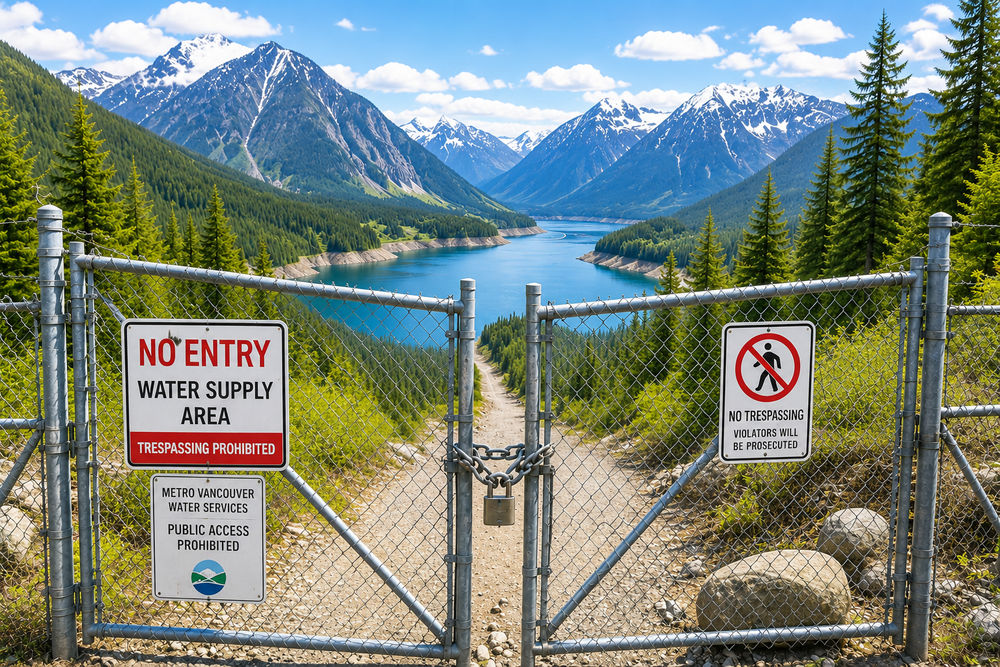
Yet some of the most beautiful mountain landscapes in British Columbia are completely off limits to the public.
You cannot hike there.
You cannot camp there.
You cannot fish there.
You cannot kayak there.
In fact, entering many areas without authorization can result in significant fines.
The reason is simple: these mountains supply drinking water to more than 2.7 million people.
Hidden behind locked gates and protected boundaries lie the Capilano, Seymour, and Coquitlam watersheds, three vast wilderness areas that form the foundation of Metro Vancouver's drinking water system.
While many residents are familiar with the reservoirs and dams visible from public viewpoints, few understand the scale of the protected wilderness beyond them.
Together, these watersheds cover hundreds of square kilometres of rugged mountain terrain, old-growth forests, rivers, streams, and reservoirs. They collect the rain and snowmelt that eventually become the drinking water flowing from taps throughout Metro Vancouver.
Protecting that water begins long before it reaches a treatment plant.
Why Public Access Is Restricted
At first glance, it may seem excessive to restrict access to such large natural areas.
After all, British Columbia is known for outdoor recreation and public access to wilderness.
However, Metro Vancouver's watersheds serve a different purpose.
Every person entering a watershed introduces potential risks to water quality.
Human activity can introduce bacteria, parasites, fuel spills, waste, litter, and other contaminants into streams and reservoirs. Even well-intentioned recreation can disturb sensitive ecosystems that help naturally filter and protect water sources.
The challenge is not simply managing one visitor. It is managing the cumulative impact of thousands of visitors over time.
Metro Vancouver's approach is based on prevention.
By limiting public access, the region reduces the risk of contamination before it occurs.
The strategy has helped preserve some of the highest-quality drinking water sources in North America.
Three Watersheds, One Water System
Although they are often discussed separately, the Capilano, Seymour, and Coquitlam watersheds function as parts of an increasingly connected regional system.
For decades, Metro Vancouver has invested billions of dollars in reservoirs, tunnels, pipelines, treatment facilities, and other infrastructure designed to improve reliability and flexibility.
This interconnected network allows water managers to balance supply and demand, respond to maintenance requirements, and improve resilience during emergencies.
What begins as rainfall and snowmelt in remote mountain valleys eventually becomes part of a sophisticated regional water network serving homes, schools, hospitals, businesses, and communities across the Lower Mainland.
How Mountain Water Becomes Safe Drinking Water
One common misconception is that Metro Vancouver simply collects mountain water and sends it directly into the distribution system.
While the source water is exceptionally clean, modern drinking water standards require multiple layers of treatment.
Water from the Capilano and Seymour watersheds flows through the Seymour-Capilano Filtration Plant, one of the most advanced drinking water treatment facilities in Canada.
There, water undergoes a series of treatment processes designed to remove sediment, organic matter, and naturally occurring microorganisms.
The system includes filtration, ultraviolet disinfection, ozone treatment, and carefully controlled chlorination.
Ultraviolet light destroys harmful microorganisms. Ozone improves water quality and helps remove taste and odour concerns. Chlorine provides ongoing protection while the water travels through hundreds of kilometres of distribution pipes.
Together, these processes help ensure that the water arriving at household taps is safe and reliable.
The Role of the Coquitlam Watershed
The Coquitlam Watershed provides an important source of storage capacity for the region and plays a key role during periods of peak demand.
As Metro Vancouver's population continues to grow, the ability to move water between supply systems becomes increasingly important.
Infrastructure projects throughout the region are helping strengthen these connections and improve long-term reliability.
Protecting a Resource Most People Never See
The irony is that most residents will never visit the wilderness areas that provide their drinking water.
That is precisely why the system works.
By keeping these watersheds protected, Metro Vancouver safeguards a resource that millions of people depend on every day.
Recent water restrictions have highlighted how important water management has become in a growing region facing changing climate conditions.
The forests, mountains, reservoirs, treatment facilities, and infrastructure that support Metro Vancouver's water supply may be largely invisible to the public, but they represent one of the region's most valuable assets.
The next time you turn on a tap, the water you see may have begun its journey in a mountain valley that you will never be allowed to visit.
And for the health of the region's drinking water system, that is exactly the point.
Karalee Greer | Vancouver City News
LinkedIn: https://www.linkedin.com/in/karalee/
Subscription to Vancouver City News is Free Interested in becoming a contributor? Become a Contributor for Free
Tags: #Vancouver City News #Metro Vancouver #Capilano Watershed #Seymour Watershed #Coquitlam Watershed #Vancouver Water Supply #Karalee Greer