Crystal Mirkazemi | Vancouver City News| August 20, 2026
When interest rates rise, the natural reaction for many investors is to become cautious. Higher borrowing costs affect mortgages, businesses, development projects and virtually every industry that depends heavily on access to capital. Real estate, in particular, tends to sit at the centre of this conversation because it is inherently capital-intensive, and changes in the cost of financing can quickly influence valuations, transactions and investor sentiment.
Yet focusing exclusively on interest rates can cause us to overlook something equally important: the underlying fundamentals of the businesses and assets we are investing in.
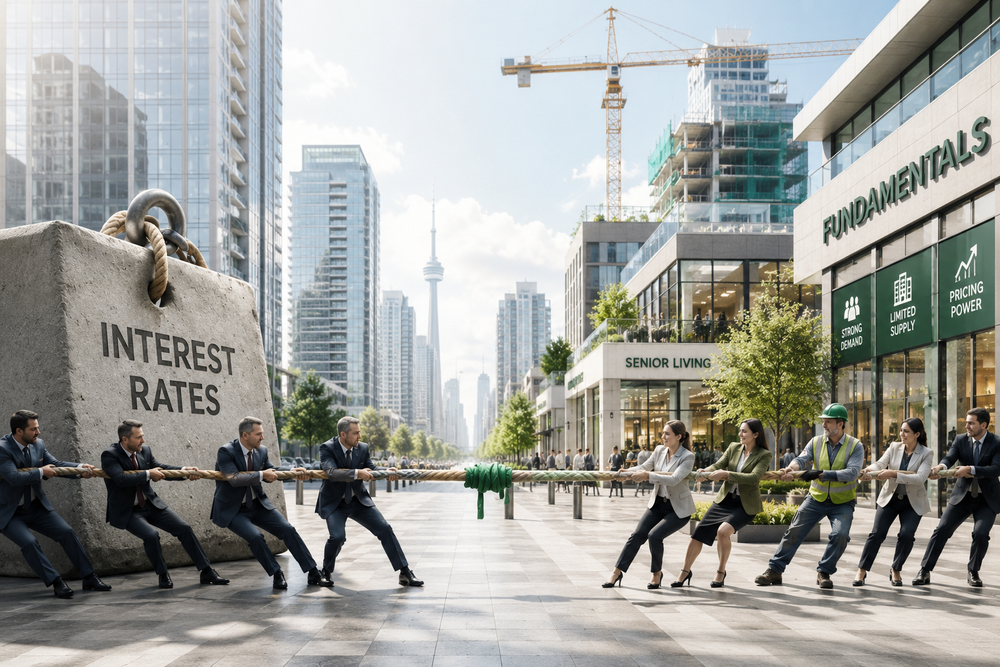
There is an ongoing tug-of-war between the cost of capital and the strength of a business. Interest rates can create pressure, sometimes significantly, particularly over shorter periods. However, over longer investment horizons, the relationship between interest rates and investment performance is not necessarily as straightforward as we might assume. Strong fundamentals such as, growing demand, limited supply, pricing power, recurring revenue and changing demographics can sometimes offset pressures created by the broader economic environment.
This distinction becomes especially interesting when we look beneath the surface of real estate and examine the businesses operating within it.
Real Estate Is More Than Buildings
The traditional image of real estate investing is relatively simple: purchase a property, collect rent, benefit from appreciation and eventually sell the asset. But many modern real estate businesses operate on a much more dynamic model.
Retail is a good example.
For years, the rise of e-commerce created the expectation that physical stores would gradually become less relevant. Online commerce undoubtedly transformed consumer behaviour, but it also introduced significant costs of its own — shipping, returns, logistics, warehousing and the increasingly expensive challenge of getting a product through the "final mile" and into the customer's hands.
That has created an interesting shift in the role of physical retail.
A store is no longer necessarily competing against e-commerce; in many cases, it complements it.
Physical locations allow customers to experience products, interact with a brand and make purchasing decisions in person, while potentially reducing some of the logistical costs associated with purely online transactions. When retailers can generate sufficient traffic and manage their inventory effectively, the economics of an in-person location can remain compelling.
The lesson for investors is broader than retail itself: we should understand how an asset actually makes money before deciding whether an entire sector is attractive or unattractive.
Demographics Can Be More Powerful Than Economic Cycles
Another compelling example can be found in senior housing and assisted living.
Canada and the United States are experiencing a significant demographic transition as their populations age. As larger numbers of people enter their later years, demand for senior housing and assisted-living services naturally increases.
At the same time, the pandemic disrupted the development of new facilities. Health concerns, uncertainty, construction challenges and changing operating conditions slowed the introduction of new supply.
The result is a potentially powerful economic combination: increasing demand meeting constrained supply.
When occupancy rises while new supply remains limited, operators may gain greater pricing power. In certain markets, rental rates can potentially increase faster than general inflation because the service being provided is not merely discretionary real estate — it addresses an increasingly important demographic need.
This is where understanding the fundamentals becomes essential.
An investor looking only at interest rates might see a capital-intensive real estate business facing elevated financing costs. An investor looking deeper might see rising occupancy, demographic demand, constrained construction and stronger pricing power.
Both observations can be true at the same time.
Investing Beyond the Headlines
Markets often encourage us to think in broad categories: interest rates are high, therefore real estate is bad; e-commerce is growing, therefore physical retail is dying; economic uncertainty is increasing, therefore investors should avoid risk.
But successful investment analysis requires another layer of questioning.
What is happening to demand? How much new supply is entering the market? Does the business have the ability to increase prices? Are customers becoming more or less dependent on the service? How efficiently is the company operating? And perhaps most importantly, are the underlying economics improving even while the headlines remain negative?
This is the difference between reacting to an economic environment and understanding what is actually happening inside an investment.
Interest rates matter. Inflation matters. Economic cycles matter, but they are only part of the equation.
Sometimes the strongest opportunities emerge precisely when macroeconomic uncertainty causes investors to overlook businesses whose fundamentals continue to strengthen.
The Value of Looking Deeper
Risk management does not mean eliminating uncertainty. It means understanding which risks matter, how they interact with one another and whether the potential return adequately compensates us for accepting them.
A higher cost of capital can place pressure on an investment, while increasing demand can pull in the opposite direction. Limited supply can strengthen pricing power, while changing consumer behaviour can create entirely new business models. Demographic trends can unfold for decades even while interest-rate cycles change every few years.
That is the tug-of-war investors should be paying attention to.
The question should therefore not simply be, "Where are interest rates going?"
A more valuable question may be:
"What fundamentals are strong enough to continue creating value regardless of where the economic cycle takes us next?"
Because markets will continue to change, interest rates will continue to move, and new risks will always emerge. The objective is not to predict every movement correctly. It is to understand what you own, recognize the forces creating long-term value, and construct an investment strategy capable of navigating the uncertainty in between.
This article is for general educational purposes and should not be considered individualized investment, tax or financial advice.
Article #041
Crystal Mirkazemi | Vancouver City News
My mission is to empower you to think big and build solutions for your family and business. Every milestone of life's journey is a chance to appreciate a financial plan. As I always say: Your most significant asset to be independent lies in your attitude towards money.
LinkedIn: https://www.linkedin.com/in/crystalmirkazemi/
Contact me here: wbn.cwc@gmail.com
Tags: #WBN News Vancouver #Crystal Mirkazemi #Build With Purpose #Financial Clarity #Timeless Principles #Intentional Living #Strategic Thinking