By Arpi Sylvester | Vancouver City News | November 26, 2026 Editor: Karalee Greer
Subscription to Vancouver News and being a Contributor is Free
Google shows local businesses based on relevance, distance and prominence. Businesses that build pages around real customer searches and earn consistent trust signals are best placed to win more calls, visits and AI search mentions.
Many local businesses don't show up in Google because their websites describe services in their own words instead of the words customers type. Google can only match a search to a page that answers it.
This matters because local search brings in many of the calls, direction requests and bookings for service businesses. Getting more visible doesn't take a trick. It takes a clear process that any owner can follow.
What Happened
Google says it ranks local results using three factors:
- Relevance: how well a business matches the search
- Distance: how close the business is to the searcher, or to the area they named
- Prominence: how well known and trusted the business is
Owners can't control where a customer is standing. They can control relevance and prominence, and that is where most of the work happens.
The Core Problem: Speaking The Wrong Language
A company may call itself a "restoration solutions provider." Its customers search for "water damage repair Burnaby." When those words don't match, the business loses visibility to competitors who use the customer's words.
A simple fix is to list 10 searches a real customer might type. For each one, note:
- The service they want
- The place they name, or the place they are in
- Whether they are ready to buy or still researching
Each of those searches should have a page that answers it directly.
Key Developments In Local Search Practice
One service, one page. A page that tries to cover five services rarely ranks for any of them. Strong service pages include:
- A title that names the service and the area
- A plain-language heading
- A first paragraph that answers the question
- Details on process, timelines and what is included
- The areas served, named naturally
- A clear next step, such as a call button or a form
Real location pages. A list of areas in the footer is not enough for businesses that serve several cities. Each main area needs its own page with local detail, not copied text.
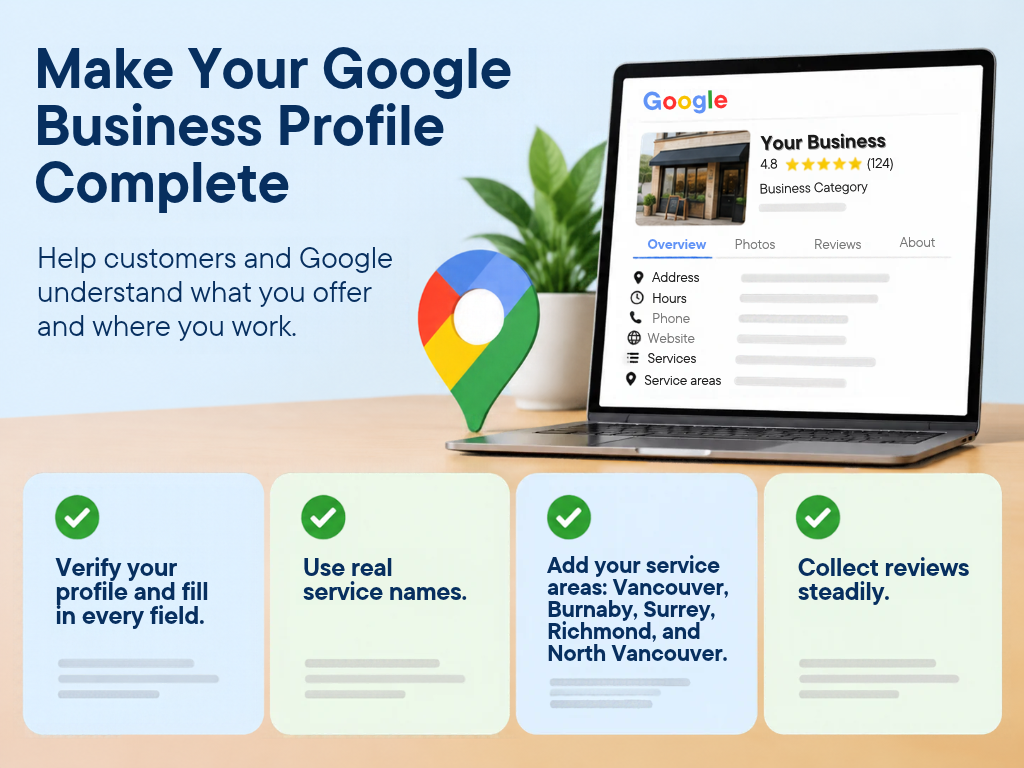
Profile and website alignment. The services and areas on a Google Business Profile should match the website. When they match, Google trusts both sources more.
Business Impact
Prominence is where many businesses try shortcuts, and those shortcuts rarely last. These signals hold up over time:
- Reviews: a steady flow of real reviews, with owner replies
- Consistency: the same name, address and phone number everywhere
- Mentions: listings and links from trusted local sources, such as chambers of commerce, industry groups and local news
- Useful content: answers to real questions that other sites want to reference
These signals now reach past Google. AI tools such as ChatGPT, Gemini and Perplexity tend to recommend businesses that are described clearly and consistently in several places.
By The Numbers
- 3: factors Google uses to rank local results (relevance, distance, prominence)
- 10: customer searches owners should map to pages as a starting point
- 11 to 79: page-one keywords a Langley law firm reached in five months, according to Hello Search Marketing
- 5 months: the time frame for that reported gain
A Quick Visibility Check
Before blaming competitors, owners can run four checks:
- Search the business name. If it doesn't appear, there may be an indexing or verification problem.
- Search a service plus the city. If the business doesn't appear, there is a relevance problem.
- Look for unindexed pages in Google Search Console.
- Test the site on a phone. Fix slow or hard-to-read pages first.
Looking Ahead
Searches for a business name can show results within days. Competitive service searches usually take months of steady work.
A Google Business Profile alone can get a business into map results. A website gives Google much more to match and gives customers a reason to trust the business. Map results tend to bring calls and direction requests. Regular results bring people who are comparing options. Most businesses need both.
Why It Matters
Local search is moving toward rewarding clear, consistent and trusted information. The businesses that gain ground will be the ones whose websites, profiles and outside mentions all describe the same services in the words customers use.
Most owners miss that this work now builds visibility on two fronts. The same steps that improve Google rankings also make a business easier for AI assistants to find and recommend. As more people use AI tools to choose local providers, businesses with patchy or mismatched information could fall behind even if their service is better.
Over the next year, expect competition to grow for both page-one positions and AI recommendations. Owners who start with customer searches, build focused pages and earn real reviews will be better placed to turn search visibility into revenue.
By Arpi Sylvester LinkedIn: https://www.linkedin.com/in/arpisylvester/ Contact: arpi@hellosearchmarketing.ca
Company: Hello Search Marketing Website: https://hellosearchmarketing.ca/ Company LinkedIn: https://www.linkedin.com/company/hello-search-marketing/home/
Editor: Karalee Greer
Subscription to Vancouver News and being a Contributor is Free
Tags: #Local SEO #Google Search #Google Business Profile #Small Business #Digital Marketing #AI Search #Online Reviews #Search Engine Optimization #Vancouver Business #Marketing Strategy