Karalee Greer | Vancouver City News | August 10-16, 2026
Subscription to Vancouver News is Free Being a Contributor is Free
Editor’s Note: “On This Week” features the strongest verified historical events connected to each calendar week. Some weeks naturally contain more major events in certain regions, so historical significance takes priority over forced geographic balance.
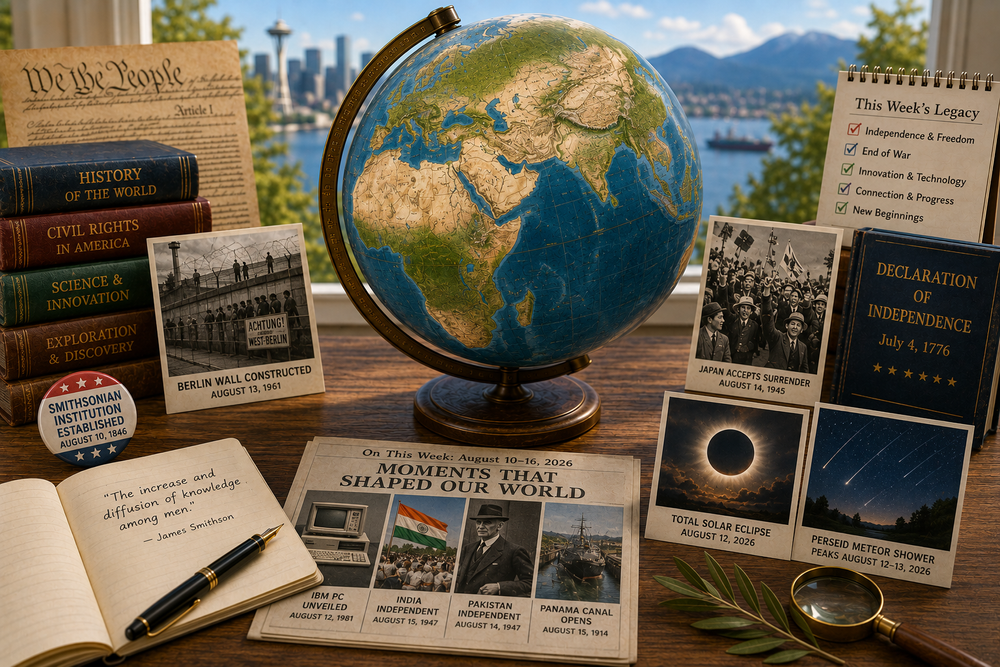
Some weeks in history seem to gather turning points. August 10 to 16 is one of them. Across these seven days, a centuries-old monarchy was brought to the brink of abolition, the Berlin Wall divided a city, the Second World War reached its end, new nations emerged from colonial rule, and one of the world’s most important trade routes opened.
The week also brought milestones in knowledge and technology, from the founding of the Smithsonian Institution to the introduction of the IBM personal computer. And in 2026, the sky itself became part of the story, with a total solar eclipse followed by the peak of the Perseid meteor shower.
History Around The World
The Americas
On August 10, 1846, U.S. President James K. Polk signed legislation establishing the Smithsonian Institution in Washington, D.C. The institution grew from an unusual bequest by British scientist James Smithson, who left his fortune to the United States for what he described as the “increase and diffusion of knowledge.” The Smithsonian has since grown into the world’s largest museum, education, and research complex.
On August 12, 1981, IBM unveiled its first personal computer, the IBM 5150, at New York’s Waldorf Hotel. Although personal computers already existed, IBM’s entry helped accelerate their adoption in businesses and homes and contributed to an industry standard that influenced personal computing for decades. The original machine started at US$1,565 and came with just 16 kilobytes of memory.
On August 15, 1914, the Panama Canal officially opened to world shipping when the steamship SS Ancon travelled through the new waterway. Connecting the Atlantic and Pacific oceans through the Isthmus of Panama dramatically shortened many maritime routes and permanently changed global shipping, commerce, and geopolitics.
Europe
On August 10, 1792, revolutionary forces stormed the Tuileries Palace in Paris, forcing King Louis XVI and his family to seek protection from the Legislative Assembly. The king was suspended and later imprisoned. The uprising effectively ended France’s constitutional monarchy, with the monarchy formally abolished the following month as the French Revolution entered a more radical phase.
On August 13, 1961, residents of Berlin awoke to find East German authorities sealing the boundary between East and West Berlin with barbed wire and other barriers. Those barriers soon developed into the Berlin Wall, which divided families, neighbourhoods, and a city for 28 years. The Wall became one of the defining physical symbols of the Cold War until its opening in November 1989.
On August 16, 1960, the Republic of Cyprus came into existence after decades of British rule. Its constitution and international agreements involving Cyprus, Britain, Greece, and Turkey took effect that day. The new republic's later history would be marked by serious tensions between Greek and Turkish Cypriots, but August 16 remains the date on which the independent Republic was established.
Asia
On August 14, 1945, Japan accepted the terms of the Potsdam Declaration and agreed to surrender to the Allied powers. News of the decision triggered celebrations across Allied countries and effectively brought the Second World War to an end after nearly six years of global conflict. Japan's formal Instrument of Surrender would be signed aboard the USS Missouri on September 2.
On August 14, 1947, the transfer of power created Pakistan as an independent state as British rule over the Indian subcontinent came to an end. Muhammad Ali Jinnah became the new nation's first Governor-General, and Pakistan has commemorated August 14 as its Independence Day ever since.
On August 15, 1947, India became an independent nation after nearly two centuries of expanding British colonial rule and decades of organized struggle for self-government. Jawaharlal Nehru became independent India's first prime minister. Independence was accompanied by Partition, which divided British India principally into India and Pakistan and triggered enormous population movements, communal violence, and loss of life.
Africa
On August 11, 1960, Chad proclaimed its independence from France, becoming another of the 17 African countries that gained independence during the extraordinary decolonization year of 1960. François Tombalbaye became the country's first president.
Science & Technology Watch
This week offers an unusual pairing of milestones separated by 135 years but connected by the same idea: making knowledge more accessible.
On August 10, 1846, the Smithsonian Institution was established with a mission centred on increasing and spreading knowledge. Today its museums, research centres, collections, educational programs, and National Zoo reach audiences far beyond Washington.
Then, on August 12, 1981, IBM unveiled the IBM PC. Its significance was not that it was the first personal computer, because it wasn't. Rather, IBM's enormous presence in the business world helped legitimize the personal computer as a mainstream tool and accelerated an ecosystem of compatible hardware and software.
Together, the two anniversaries capture something remarkable about the evolution of knowledge: from national collections housed in museums and research institutions to computing power increasingly available on people's desks.
Weather & Nature Watch
A Remarkable Week In The Sky
This year's August 10–16 week brought an exceptional pairing of astronomical events.
On August 12, 2026, a total solar eclipse swept across parts of the Northern Hemisphere. Totality crossed Greenland, Iceland, northern Russia, Spain, and a small part of Portugal, while a partial eclipse was visible across much of Europe and portions of North America and northwestern Africa. For most locations in the path of totality, the Sun was completely covered for less than two minutes.
Then, during the night of August 12 into August 13, the annual Perseid meteor shower reached its peak. This year offered particularly favourable viewing conditions because the shower coincided with a New Moon, leaving the night sky unusually dark. NASA describes the Perseids as one of the year's best annual meteor showers.
There is another major natural story unfolding beneath those skies.
The World Meteorological Organization reports that El Niño has developed in the tropical Pacific and is strengthening rapidly. Its July seasonal outlook indicated development toward a strong event during July through September, with unusually warm waters across the central and eastern equatorial Pacific.
Those warming waters are already having visible ecological consequences. Researchers are observing unusually large numbers of South American seabirds as far north as Panama as warming Pacific waters alter the location of fish on which they depend.
From an eclipse overhead to changes unfolding across the Pacific Ocean, this week's natural events are reminders that the planet's story continues alongside the history we inherit.
Series Note: “On This Week” explores significant global events, discoveries, turning points, and cultural milestones connected to each calendar week throughout the year
Karalee Greer | Vancouver City News
LinkedIn: https://www.linkedin.com/in/karalee/
Subscription to Vancouver City News is Free Interested in becoming a contributor? Become a Contributor for Free
Tags: #Vancouver City News #On This Week #World History #Karalee Greer #Interesting Facts #Global Events #Berlin Wall #World War II #Panama Canal #Solar Eclipse